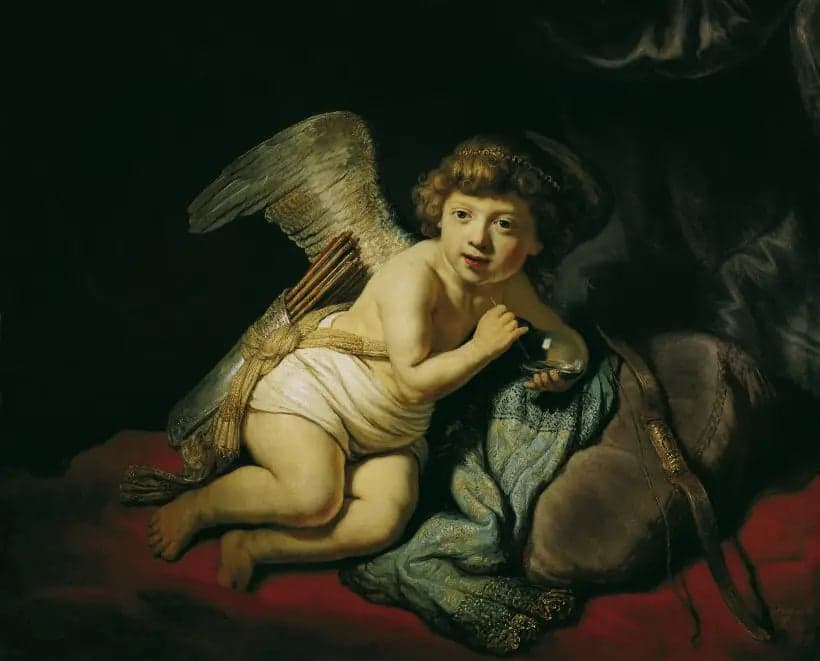
Cupid with the Soap Bubble
- Original dimensions
- 92.6 x 75 cm
- Museum
- Liechtenstein Museum
- Year
- 1634
Scene depicted
In this pictorial work , we discover Cupid, the god of love, absorbed in the contemplation of a sparkling soap bubble. The scene is a living tableau of sweetness and peace, a metaphor for the innocence and fragility of love. The enchanting gaze of the young god, combined with the glow of the bubble, creates an ethereal atmosphere that invites us to reflect on the fleeting nature of happiness and feelings.
Historical context
Created in 1634, during the Dutch Golden Age, this painting is set in a flourishing context of artistic creativity in Amsterdam. The painting, currently housed in the Liechtenstein Museum in Vienna, brilliantly illustrates the baroque movement, revealing both the mastery of Rembrandt and the unique emotion that emanates from his works. The canvas of 92.6 x 75 cm explores an intimate scene, suspended between dream and reality.
Place in the artist's career
This painting sits at a crossroads in the career of Rembrandt , illustrating his transition from a promising young artist to a master of light and emotion in his compositions. At this time, other paintings such as “The Anatomy Lesson of Dr. Tulp” and “The Girl with a Pearl Earring” already show his penchant for visual storytelling and character exploration. Each work bears witness to a technical evolution and a growing maturity in his approach to the human theme.
Anecdote
Rembrandt , this great master of light and shadow, is said to have declared: “Every brushstroke must be a caress of the soul.” Imagine him in his studio one spring morning, enveloped by the scents of fresh paint. The idea of capturing Cupid in such a delicate moment, deep in contemplation of a soap bubble, illustrates the refined blend of innocence and ephemeral beauty. This emotion is at the heart of the painting .