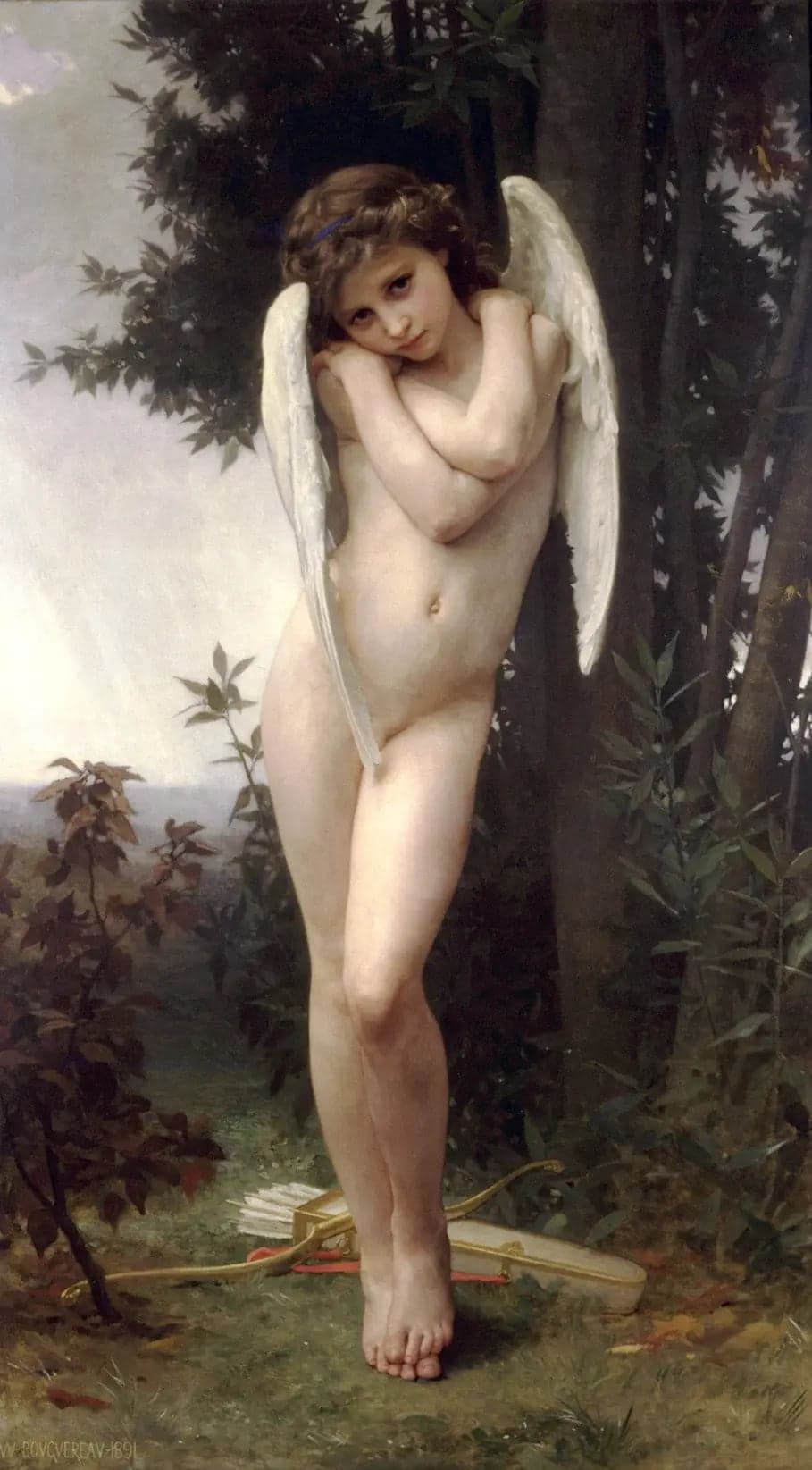
Cupid
- Original dimensions
- 84.5 x 155.5 cm
- Movement
- academicism
- Museum
- Not specified
- Year
- 1891
Scene depicted
The captivating scene depicts Cupid, the god of love, in a moment of grace where innocence and passion intertwine. Bouguereau captures the soft light that envelops the young archer, accentuating his delicate expression. The canvas evokes a poetic universe where mythology and reality intertwine, inviting the viewer to dive into a world where love triumphs and beauty reigns.
Historical context
Created in 1891, this painting is emblematic of the academic movement that dominated the French artistic scene at the end of the 19th century. In a context of refinement and aesthetic research, Cupid reflects beauty and harmony, values dear to the artist. Although the work is not displayed in a specific museum, its dimensions of 84.5 by 155.5 cm testify to the grandeur and importance of this painting in Bouguereau's repertoire.
Place in the artist's career
Cupid is a true marker in Bouguereau's career. While the artist had already achieved some renown with paintings such as “The Child with the Drum” and “Fortune,” this painting illustrates his stylistic peak. Here, he skillfully combines academic technique with strong emotional sensitivity, marking an evolution in his artistic approach.
Anecdote
“Art must be the reflection of the most sincere emotions,” said Bouguereau. Inspired one spring morning, the painter observed an innocent child playing in the sun. This vision of purity and love nourished the artist's heart, inspiring him to represent Cupid with palpable tenderness, transforming his inspiration into a masterpiece .