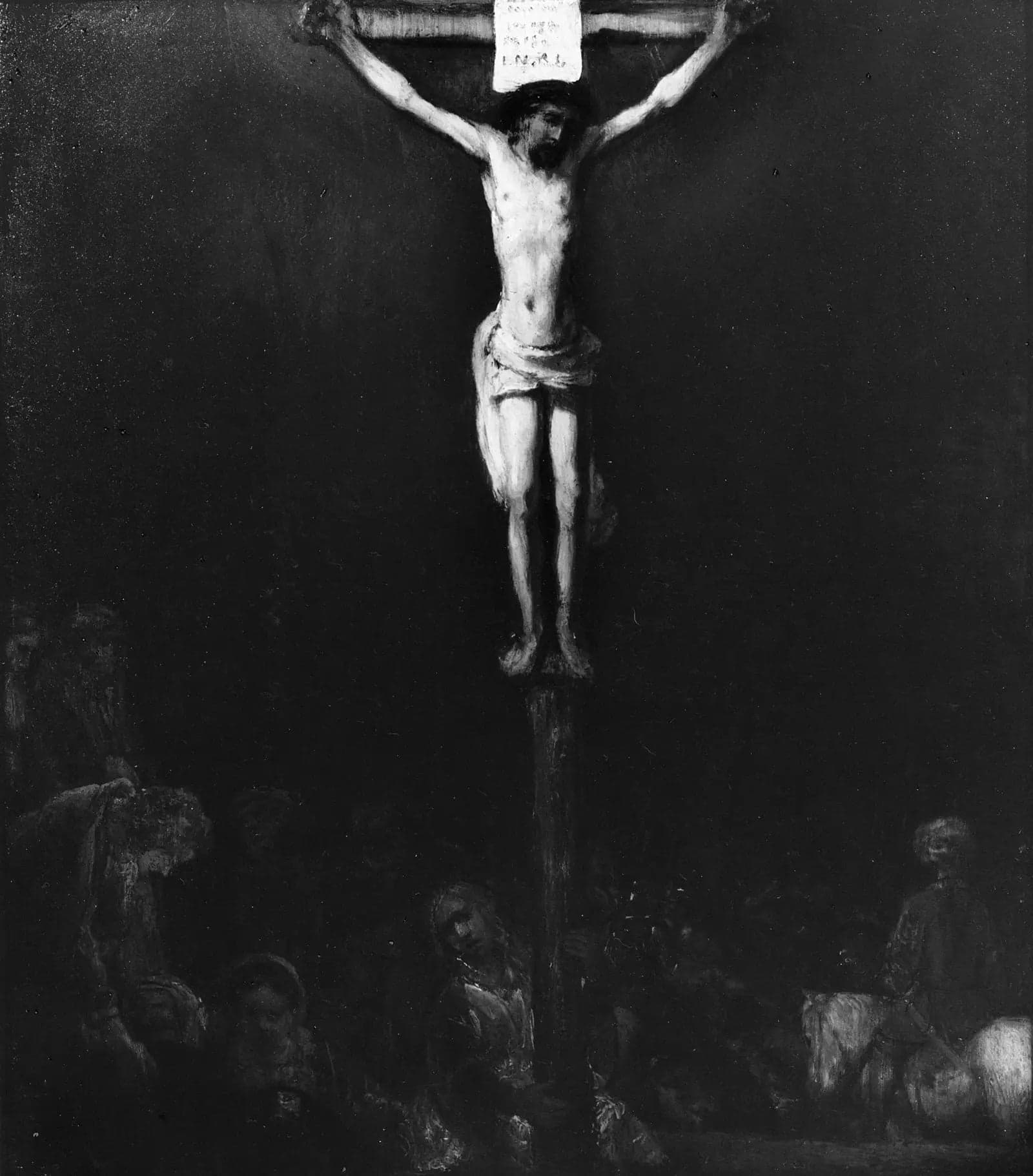
Crucifixion
- Original dimensions
- 28.6 x 32.9 cm
- Museum
- Clark Art Institute
- Year
- 1657
Scene depicted
In this painting , Rembrandt stages the tragic moment of the crucifixion, an event that is both painful and outside classical norms. The characters, beset by varied emotions, tell a story of sacrifice and despair. Divine light, intense, wisely illuminates and dramatizes the whole, revealing human vulnerability and pain in the face of mortality.
Historical context
Created in 1657, the painting "Crucifixion" by Rembrandt is rooted in Amsterdam, illustrating the emotional depth of the baroque movement. At that time, the city concentrated artistic genius, and Rembrandt , a prominent figure, established himself through his innovative use of light and shadow. Currently exhibited at the Clark Art Institute , this canvas reveals itself through modest dimensions that testify to a concentration of narrative power.
Place in the artist's career
"Crucifixion" marks a turning point in Rembrandt's career, a period where his mastery was affirmed. Echoing "The Night Watch" and "The Anatomy Lesson of Dr. Tulp," he highlights a stylistic evolution where drama and emotion transcend the conventions of the time, breathing new life into his canvases .
Anecdote
"Art is a capture of emotion," Rembrandt might have said as he leaned over his canvas one peaceful morning, cradled by the song of birds. Inspiration came from a sunlit alley, where every face encountered evoked suffering and resilience. This pictorial work is much more than a representation: it is a communion with the human soul.