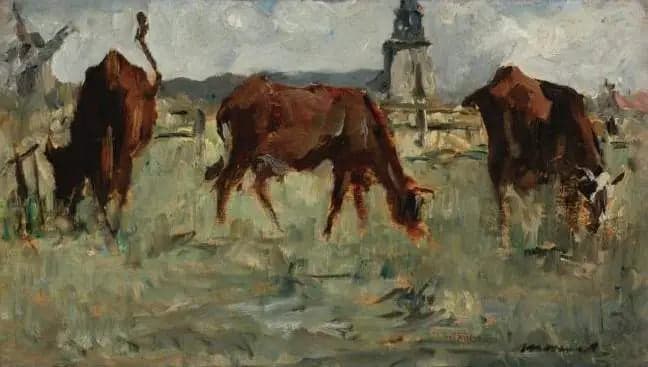
Cows in Pasture
- Original dimensions
- 21.5 x 12.5 cm
- Museum
- Not specified
- Year
- 1873
Scene depicted
In this canvas, a bucolic scene comes to life: cows are lounging peacefully under the benevolent gaze of a bright sky. The composition, all in delicacy, takes us into the calm of a suspended moment. One perceives the serenity of the rural world, highlighting a striking contrast with the urban agitation of the time, thus capturing the essence of a painting where each brushstroke tells a story.
Historical context
Created in 1873, this iconic painting finds its roots in the artistic Paris of the 19th century, a time of cultural upheaval and pictorial renaissance . Édouard Manet , a leading figure of the Impressionist movement, develops this painting through an innovative gaze, capturing the very essence of the rural landscape of his time. While the current host museum remains unspecified, its delicate size of 21.5 x 12.5 cm evokes visual intimacy, inviting us to dive into the heart of the work.
Place in the artist's career
Cows in the Pasture represents a crucial milestone in Manet's career, a period of maturation and affirmation of his unique style. Compared to other works such as “Luncheon on the Grass” and “Olympia,” this painting reflects the technical and emotional evolution of the artist. Manet begins to emancipate himself from conventions to embrace a form of expression that is freer, oscillating between tradition and modernity.
Anecdote
“Nature is a painting that can never be fully reproduced,” said Manet, evoking the magic of light and forms. The genesis of this masterpiece may have been inspired during a walk along the Seine, where he might have encountered peaceful cows basking in the gentle spring light. This painting, like an ode to simplicity, captures this emotion with unparalleled depth.