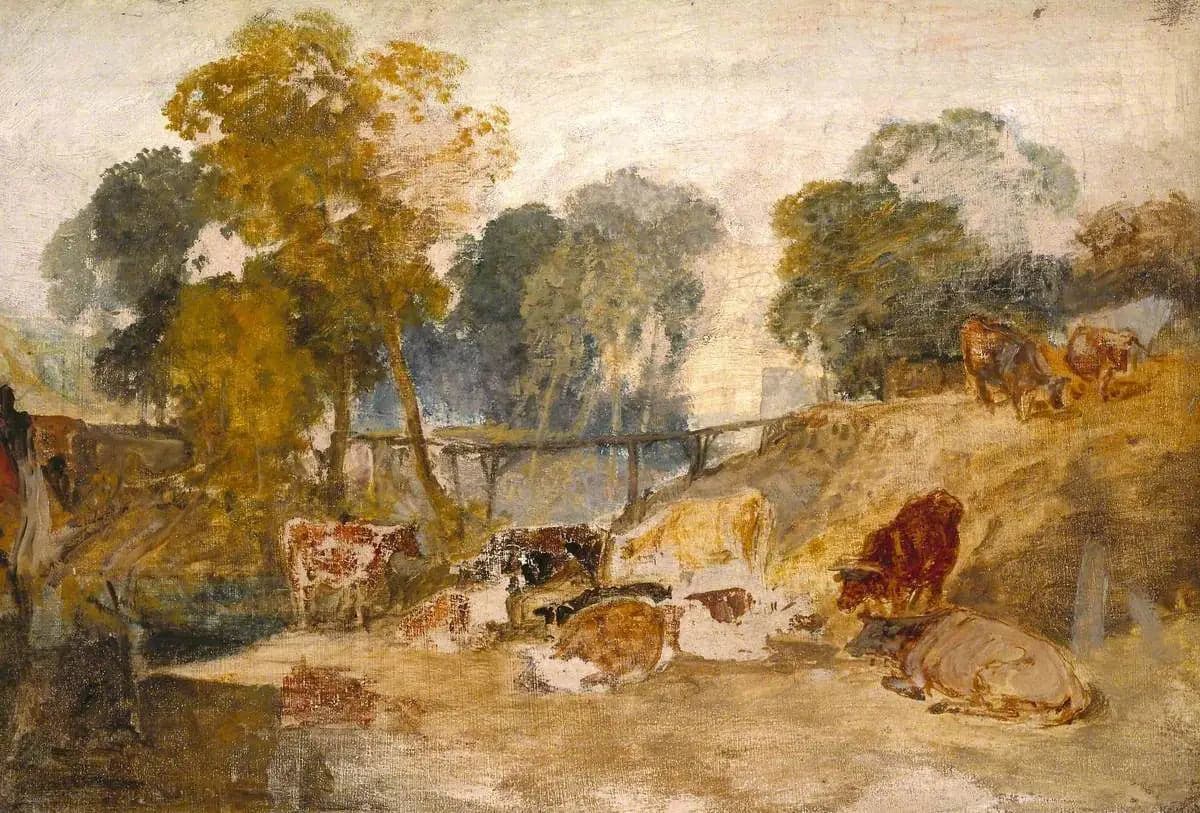
Cows in a Landscape with a Footbridge
- Original dimensions
- 47.9 x 71.1 cm
- Museum
- Tate
- Year
- 1806
Scene depicted
In this canvas , a perfect harmony reigns between the peaceful cows and the natural elements surrounding them. Turner, with his skill, managed to convey a serene atmosphere. The presence of a small wooden bridge connects man and nature, while the bright colors and play of light evoke an enchanting day. Every detail is thoughtful, from the lush grass to the delicate sunlight, capturing a moment suspended in time.
Historical context
Created in 1806, this painting emblematic of the great master Turner reflects a time when romanticism began to shape British art. Set in London, the scene depicts an idyllic landscape where cows stand innocently in vibrant nature, captured by Turner's unique vision. Currently, the canvas is housed at the Tate , among the most beautiful art collections in the world.
Place in the artist's career
This canvas marks a turning point in Turner's career, symbolizing his rising value in the art world. Like his other works, such as "The Fighting Temeraire" and "Rain, Steam and Speed," "Cows in a Landscape with a Footbridge" showcases the evolution of an increasingly bold style where light and color become full-fledged protagonists.
Anecdote
Joseph Mallord William Turner once stated: "Nature is the greatest artist of all." It was in the soft light of a spring morning, while wandering in the countryside, that he found inspiration for this masterpiece . The painting "Cows in a Landscape with a Footbridge" conveys this deep connection between the artist and nature, paying tribute to the tranquility one can feel in the countryside.