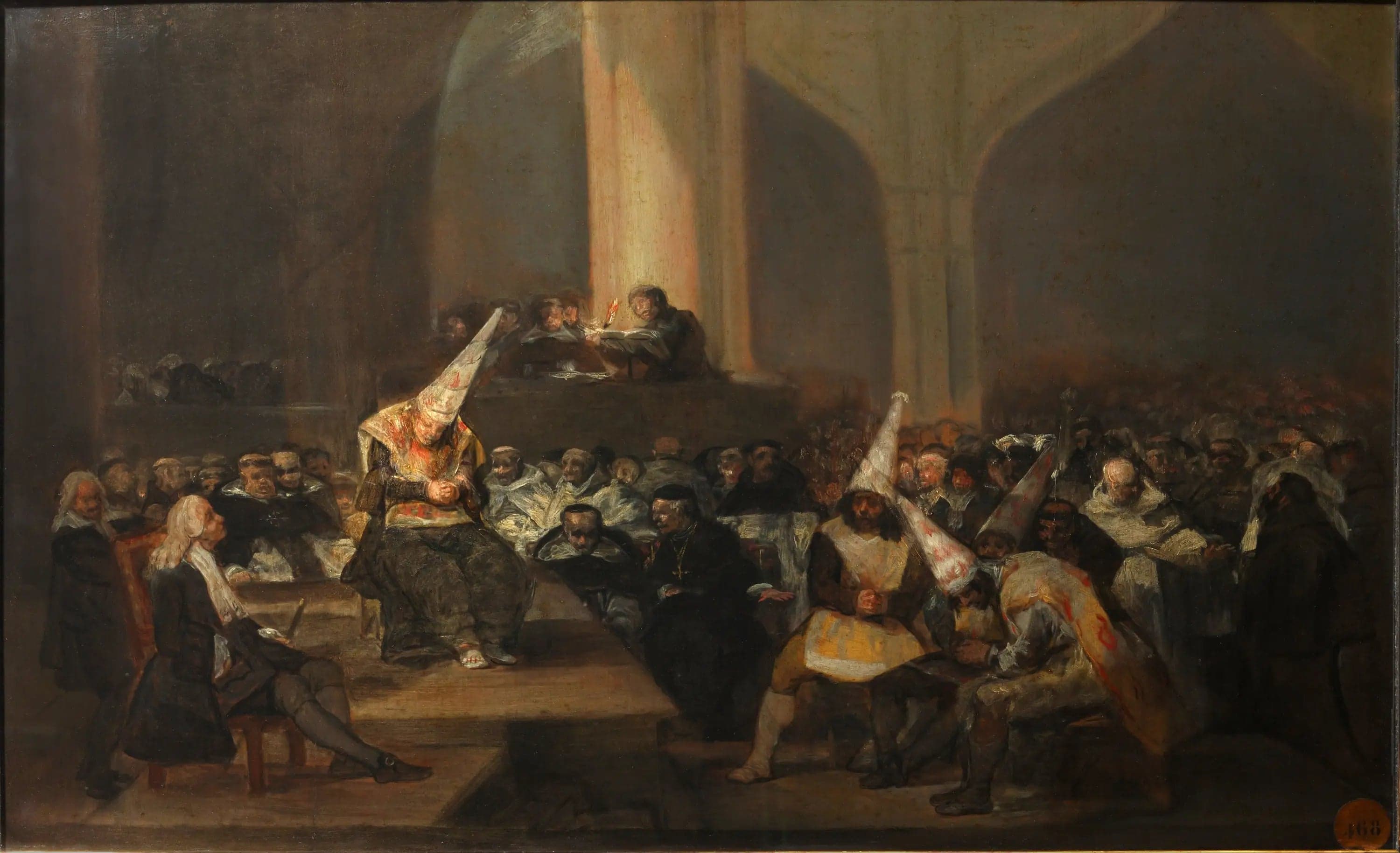
Court of the Inquisition
- Original dimensions
- 73 x 46 cm
- Museum
- Royal Academy of Fine Arts of Saint Ferdinand
- Year
- 1812
Scene depicted
The canvas “Tribunal de l'Inquisition” depicts a poignant and tragic scene. The characters, with faces distorted by anguish, are subjected to the severe authority of the inquisitors. The palpable tension evokes the struggle between faith and doubt, revealing the horrors of a ruthless system that marked Spain. A striking composition that questions our own relationship with fear and justice.
Historical context
Created in 1812, in the heart of Madrid, this painting is emblematic of the romantic movement that emerged in reaction to neoclassical constraints. Goya, during a period marked by political and social turmoil, emphasizes the dark realities of humanity. Currently, the canvas rests in the illustrious Royal Academy of Fine Arts of Saint Ferdinand, where it continues to awaken the soul of visitors.
Place in the artist's career
This canvas constitutes a turning point in Goya's career, marking a transition to a more personal and engaged style. Compared to “La Maja desnuda” and “Saturn Devouring One of His Sons,” one perceives how his art evolves here towards the denunciation of injustices, humanizing itself while retaining a tragic intensity.
Anecdote
“The light of truth often hides in the shadow of pain.” Goya, meditating on the Inquisition, drew his inspiration while wandering through the dark alleys of Madrid, facing faces marked by fear and silence. This quote resonates throughout his work, the painting attracting the gaze, the soul touched by its authenticity.