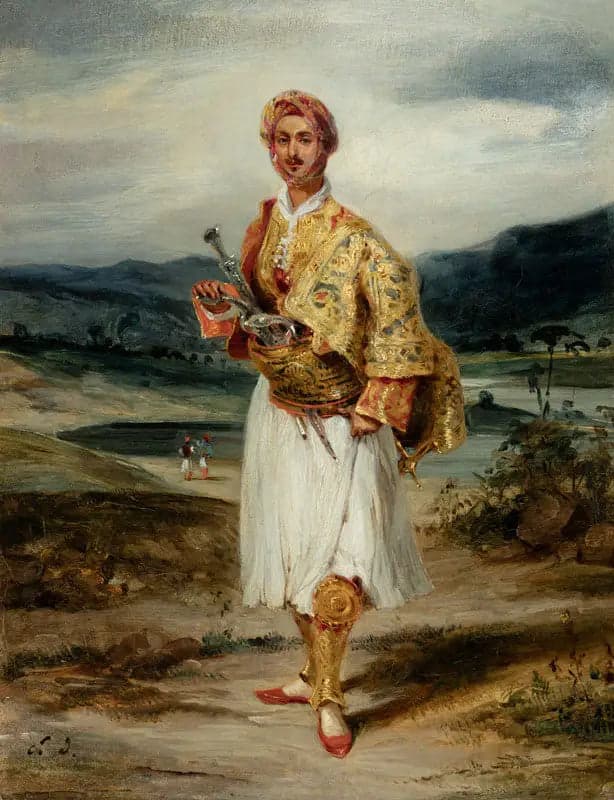
Count Palatiano in Suliot Costume
- Original dimensions
- 26 x 34 cm
- Museum
- National Gallery in Prague
- Year
- 1826
Scene depicted
The canvas highlights a striking portrait of Count Palatiano, dressed in his traditional Suliot costume. The composition depicts a stolen moment, where the elegance of the character unfolds through the meticulous details of the costume, symbolizing both his heritage and determination. Every element of the canvas breathes the vibrancy of the era, capturing the interaction between the subject and his environment.
Historical context
Artwork: Count Palatiano in Suliot Costume |BRK| Artist: Eugène Delacroix |BRK| Year: 1826 |BRK| Museum: National Gallery in Prague |BRK| Dimensions: 26 x 34 cm |BRK|
Place in the artist's career
This canvas fits into a period of maturity for Delacroix, representing a stylistic peak of his career. Like his major works such as Liberty Leading the People and The Massacres of Scio , Count Palatiano in Suliot Costume illustrates the evolution of his pictorial approach, combining expressive power and refined technique, marking a turning point in his exploration of human passions.
Anecdote
“Painting, for me, is a cry of the soul,” Delacroix reportedly said while contemplating his work. That morning, by the edge of a peaceful lake, he met the intense gaze of Count Palatiano, a vision destined to mark eternity. Inspired by this encounter, the painting comes to life, evoking strength and nobility through every brushstroke.