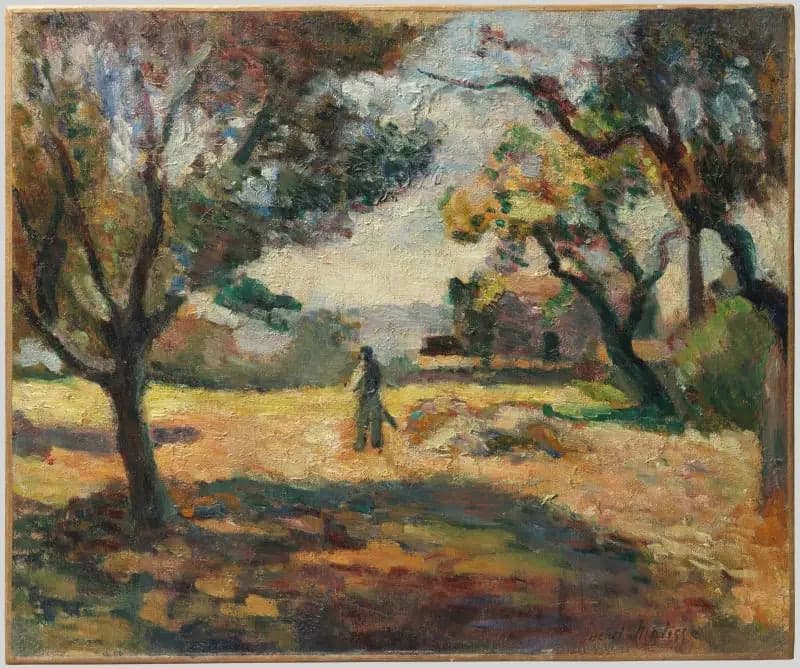
Corsican Landscape
- Original dimensions
- 46.36 x 38.43 cm
- Museum
- San Francisco Museum of Modern Art
- Year
- 1898
Scene depicted
In this canvas , Matisse offers us a striking portrait of the wild beauty of Corsica. The painting depicts golden sand where paths weave between the mountains, enveloped by the glimmers of a azure sky. Each brushstroke breathes the sea breeze, blowing through the tangle of foliage that surrounds this idyllic scene.
Historical context
Created in 1898, this painting is emblematic of the Fauvist movement, which celebrates intense color and freedom of expression. Henri Matisse , then a young artist, finds inspiration in the bright landscapes of Corsica, this sun-drenched Mediterranean island filled with the fragrances of maquis. Today, the canvas is preserved at the San Francisco Museum of Modern Art, testament to its lasting impact on the art world.
Place in the artist's career
“Corsican Landscape” marks a crucial milestone in Matisse's career, a turning point towards his Fauvist style. At this time, he also creates “The Joy of Life” and “Woman with a Hat,” where he experiments with bold palettes. Together, these works illustrate his transition from classic impressionism to more avant-garde explorations.
Anecdote
“Color must be like an ode to life,” Matisse might have declared while contemplating this Corsican landscape. Infused with vibrant colors, he captured the softness of a summer morning, where the sea intertwines with the hills. This painting thus evokes the awakening of the senses, a communion with nature that still inspires today.