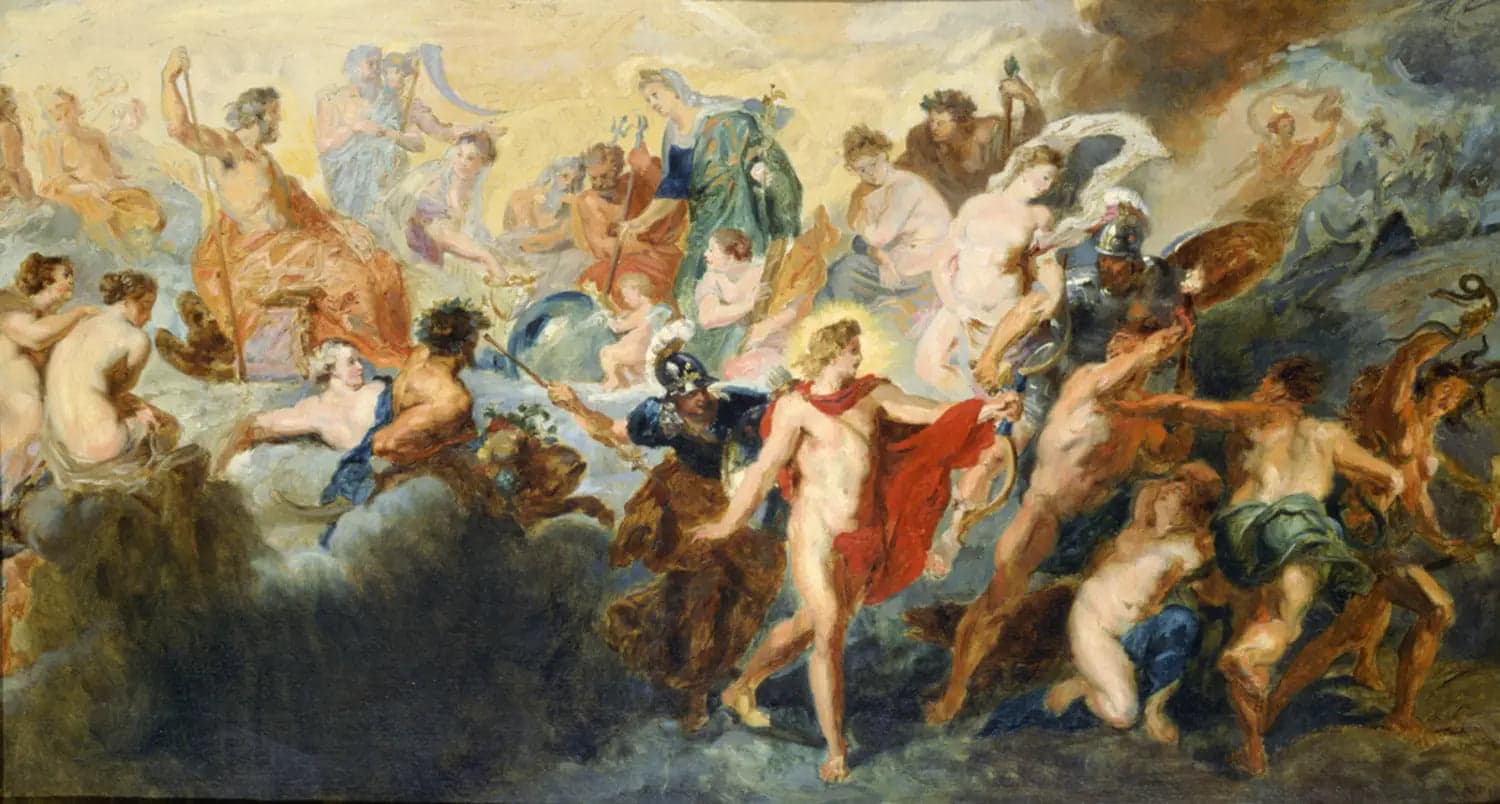
Copy after the painting by Rubens "The Council of the Gods" - Pierre
- Original dimensions
- 83.5 x 45.8 cm
- Museum
- National Museum of Western Art
- Year
- 1861
Scene depicted
This painting evokes a celestial assembly, where each mythological figure, essential to the narrative, discusses human destinies. The choice of characters, their gestures, and the interactions create a powerful dynamic, transcending time and space, inviting viewers to a deep reflection on the duality between the divine and humanity.
Historical context
Created in the heart of the 19th century, this canvas stands out for its affiliation with a vibrant artistic movement, Impressionism , while drawing inspiration from the Baroque spirit of the great master Rubens. It is in the historical context of Paris, an emblematic city of artistic culture, that Renoir, in full exploration of his creativity, brings this masterpiece back to life. Today, the painting proudly occupies a place at the National Museum of Western Art , testifying to its eternal value.
Place in the artist's career
This canvas represents a key phase in Renoir's career, marking him as an artist in full bloom. While other paintings like "Luncheon of the Boating Party" and "The Bathers" affirm his imminent style, this reproduction of Rubens' painting is a marker of his ability to infuse his own artistic identity into the creations of the old masters.
Anecdote
“Beauty lies in the details,” said Renoir. It was on a warm spring morning, by the banks of the Seine, that he captured the essence of this painting . A breath of life, a burst of light filtering through the foliage, this moment of inspiration allowed him to create a pictorial work that speaks to the soul and transports us to the heart of the divine narrative, in the painting of the Council of the Gods.