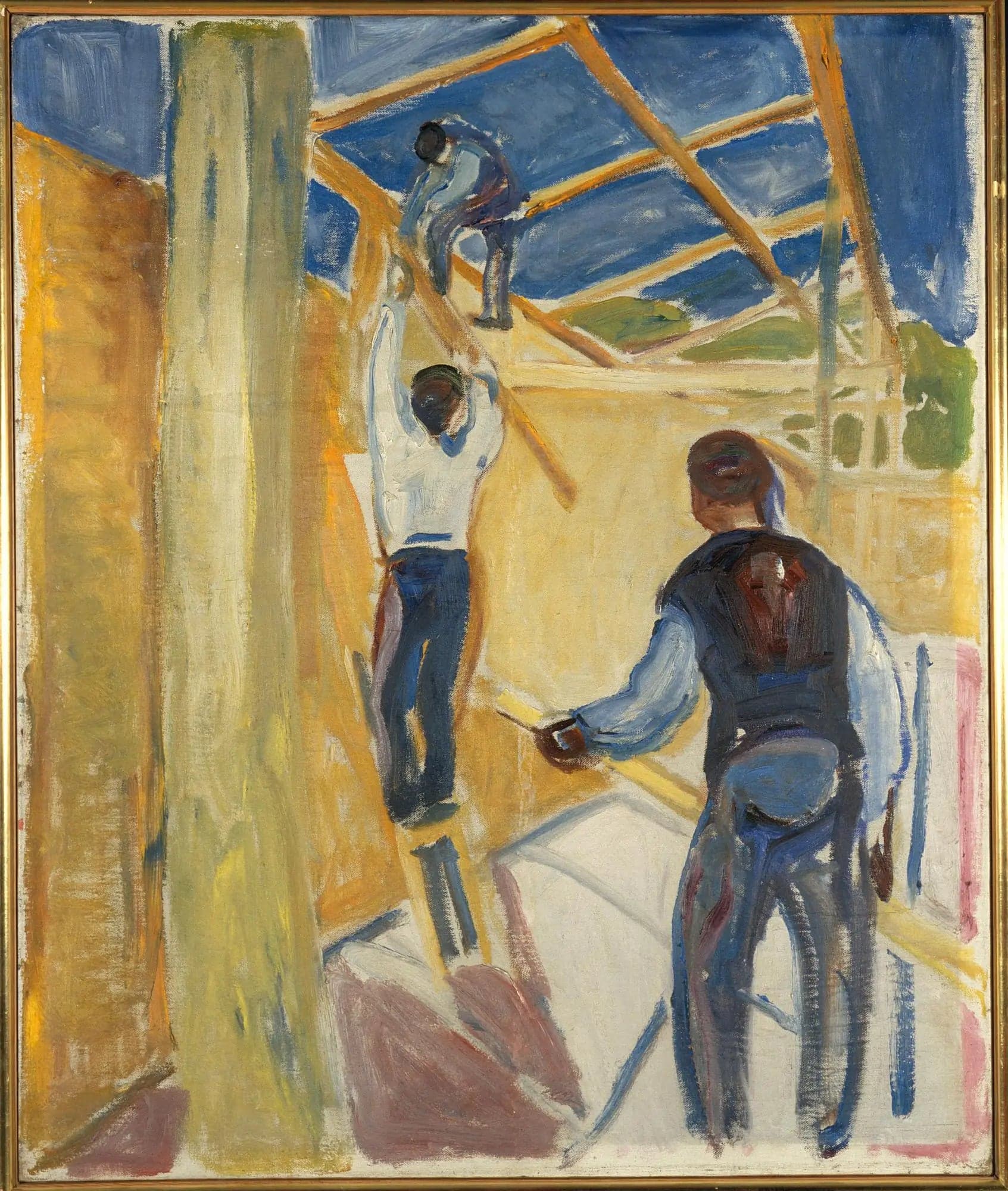
Construction Workers in the Studio
- Original dimensions
- 120 x 90 cm
- Museum
- Munch Museum
- Year
- 1920
Scene depicted
This painting illustrates a group of workers in their workplace, where the intensity of real life meets art. The deeply human scene draws inspiration from the collective fervor of the laborers, accurately conveying the strength of the group, their silhouettes marked by the golden sunlight filtering through the windows. Every detail of this canvas tells a vibrant story, from physical effort to the hope for a better future.
Historical context
Created in 1920, this painting embodies the expressionist movement, defined by its ability to translate the emotional turmoil of the time. Located in the Munch Museum in Oslo, this canvas reflects a rapidly changing urban environment, where the workers symbolize a powerful representation of early 20th-century society.
Place in the artist's career
This painting marks a phase of maturity for Edvard Munch , where his style fully blossoms. Parallel to major works such as The Scream and The Madonna, Workers in the Studio adds a social and collective dimension that enriches his personal expressionism , revealing the struggle for identity in a changing society.
Anecdote
“Art must transcend the everyday.” These words, filled with passion, resonate with Munch's creative process. On a sunny morning, observing these workers, he captured the contrast between the city's vibrancy and the melancholy of the moment, a force that materializes in his masterpiece, the painting Workers in the Studio.
Major exhibitions
Munch og Ekely: 1916-1944