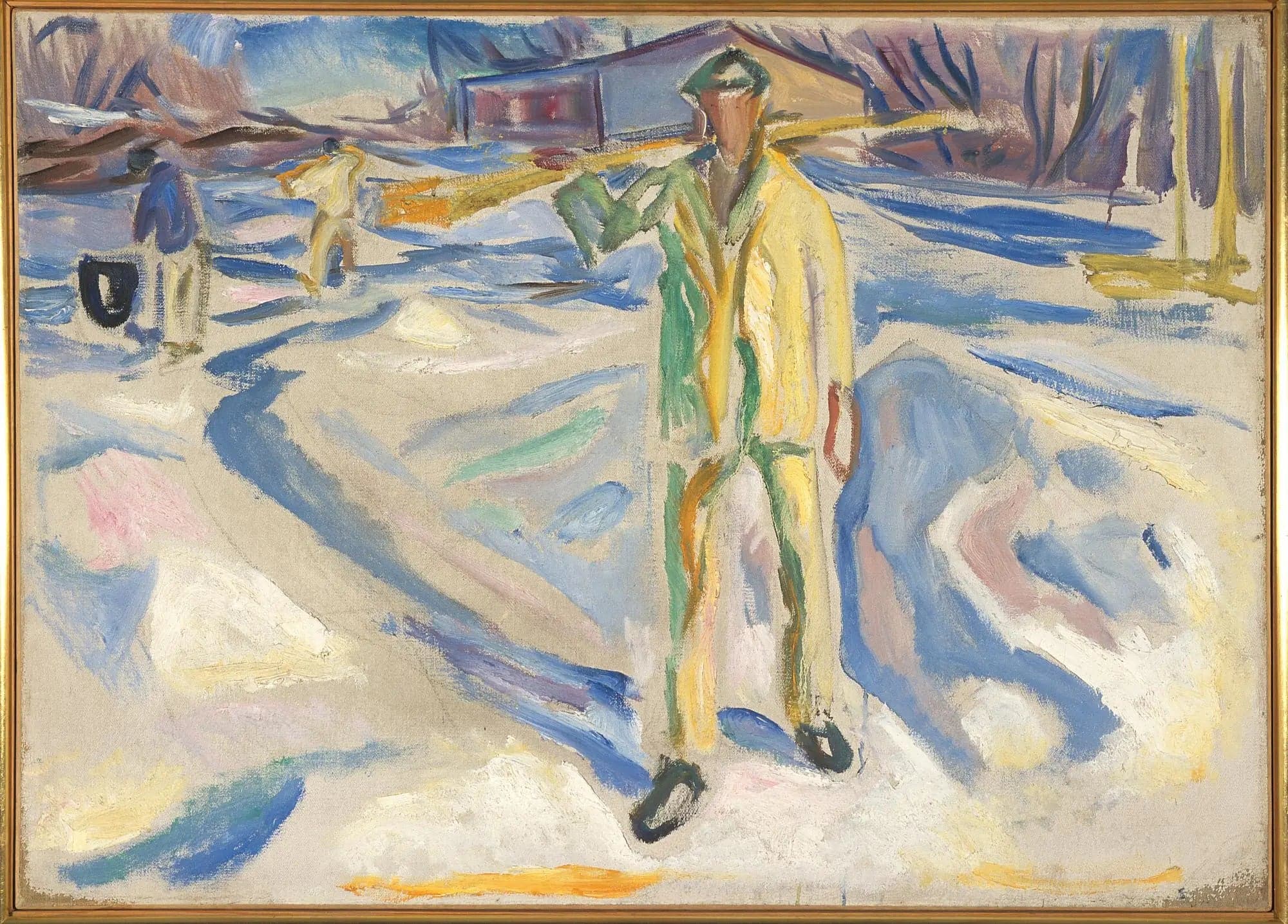
Construction Workers in the Snow
- Original dimensions
- 100 x 72 cm
- Museum
- Munch Museum
- Year
- 1920
Scene depicted
Workers in the Snow depicts human silhouettes emerging in a winter landscape, struggling against the elements. In a setting where the biting cold envelops the men, Munch transcends simple representation. The painting reveals both the hard labor and the humble dignity of the workers, uniting their fate with the drama of nature. Each figure, frozen in effort, dialogues with the heavy silence of the snow that covers the world.
Historical context
Created in 1920, this painting is part of the artistic effervescence of the early 20th century, in Oslo, Norway, a period marked by emotional explorations and stylistic innovations. The expressionist movement, with which Edvard Munch is so deeply associated, elevated inner feelings to the forefront, uniting the intimate with the collective American and European contexts. Today, this canvas holds a privileged place in the Munch Museum where it continues to captivate art lovers with its iconic dimensions of 100 x 72 cm.
Place in the artist's career
This canvas finds its place at the heart of Munch's production, acting as a revealer of his sensitivity to human suffering. When comparing Workers in the Snow to The Madonna or The Scream, one perceives an evolution towards a more social approach to his subjects. It symbolizes the maturity of the artist, a region of contrasts between personal anguish and universal human condition.
Anecdote
“Every gust of snow reminds me of the weight of the world on the shoulders of the workers,” Munch might have said while observing these laborers facing the harshness of winter. The torments of a freezing morning, between cries of life and whispers of solitude, inspired this canvas vibrant with emotions. Emerging from the shadows, each brushstroke becomes an ode to struggle and resilience, revealing the hidden pains behind daily work.
Major exhibitions
Edvard Munch . Monumental projects