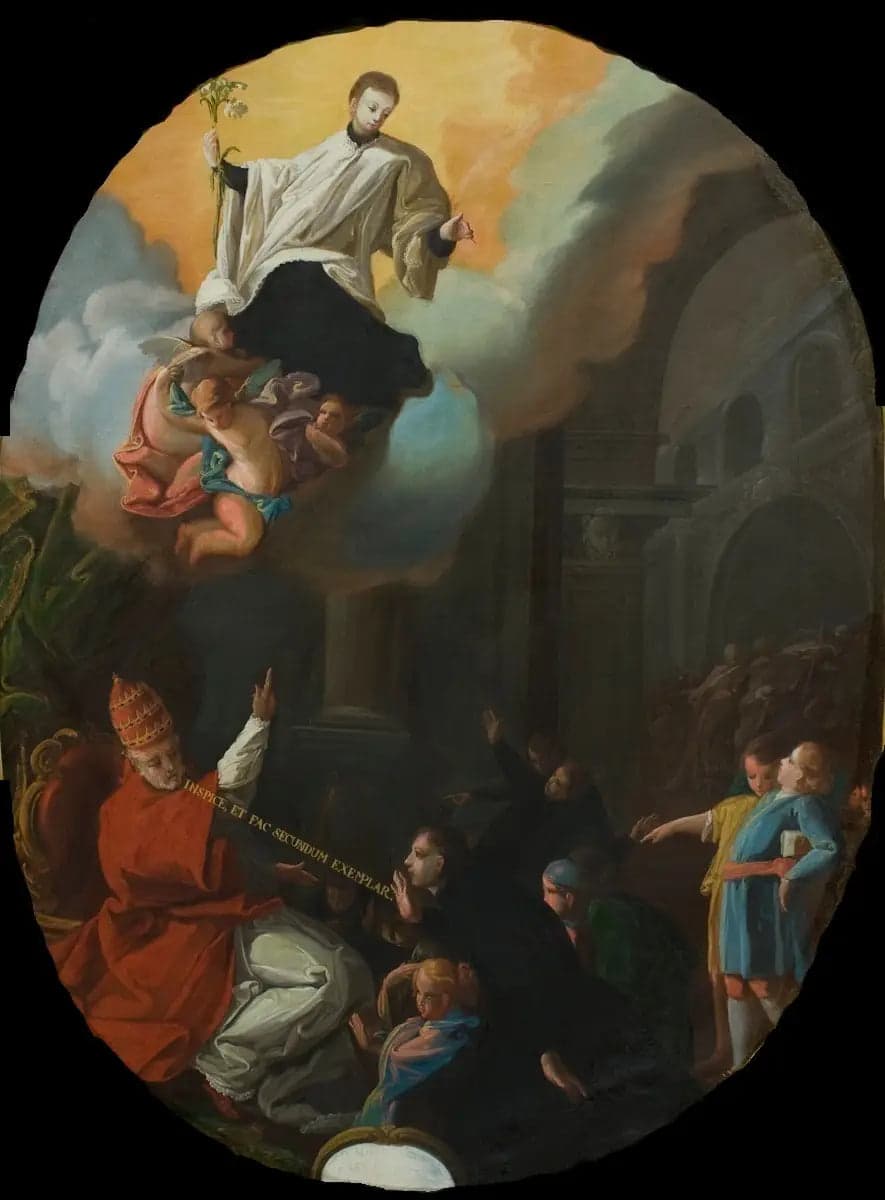
Consecration of Saint Louis of Gonzaga as Patron of Youth
- Original dimensions
- 88 x 127 cm
- Museum
- Musée de Saragosse
- Year
- 1763
Scene depicted
The painting solemnly illustrates the moment when saint Louis de Gonzague is proclaimed the patron of youth, in the presence of an attentive assembly. At the center of the composition , the saint raises his arms, and his figure petrified by an Olympian light resonates with a feeling of spiritual elevation. The magnificence of the scene unfolds in a dialogue between heaven and earth, where each detail tells a timeless story of devotion and inspiration.
Historical context
Created in 1763, the painting emblematic of Goya, “Consécration de saint Louis de Gonzague comme patron de la jeunesse”, comes from the heart of Saragosse, a city rich in history and culture. This painting is part of the Rococo movement, blending delicacy and depth in its composition, while bearing the traces of the social concerns of its time. Today, this canvas is precious preserved at the Musée de Saragosse, a true sanctuary for art lovers.
Place in the artist's career
This painting marks a turning point in Goya's career, revealing his exceptional potential. Before this masterpiece , he had already exhibited promising works such as “Les Moulins de Bambou” and “Le Spectacle des Pêcheurs”, but “Consécration de saint Louis de Gonzague” proves to be an emblematic work, paving the way for his deeper exploration of human emotions. This painting heralds the future masterpieces that will mark his artistic maturity.
Anecdote
Goya once said: “The painting is the silent cry of the soul.” It is with this vivid thought that he created this work, inspired by a sweet summer morning, where the golden light bathed the streets and faces, illuminating his creative spirit. In this painting , the young saint Louis de Gonzague seems to embody this call, elevating youth towards ideals of hope and purity.