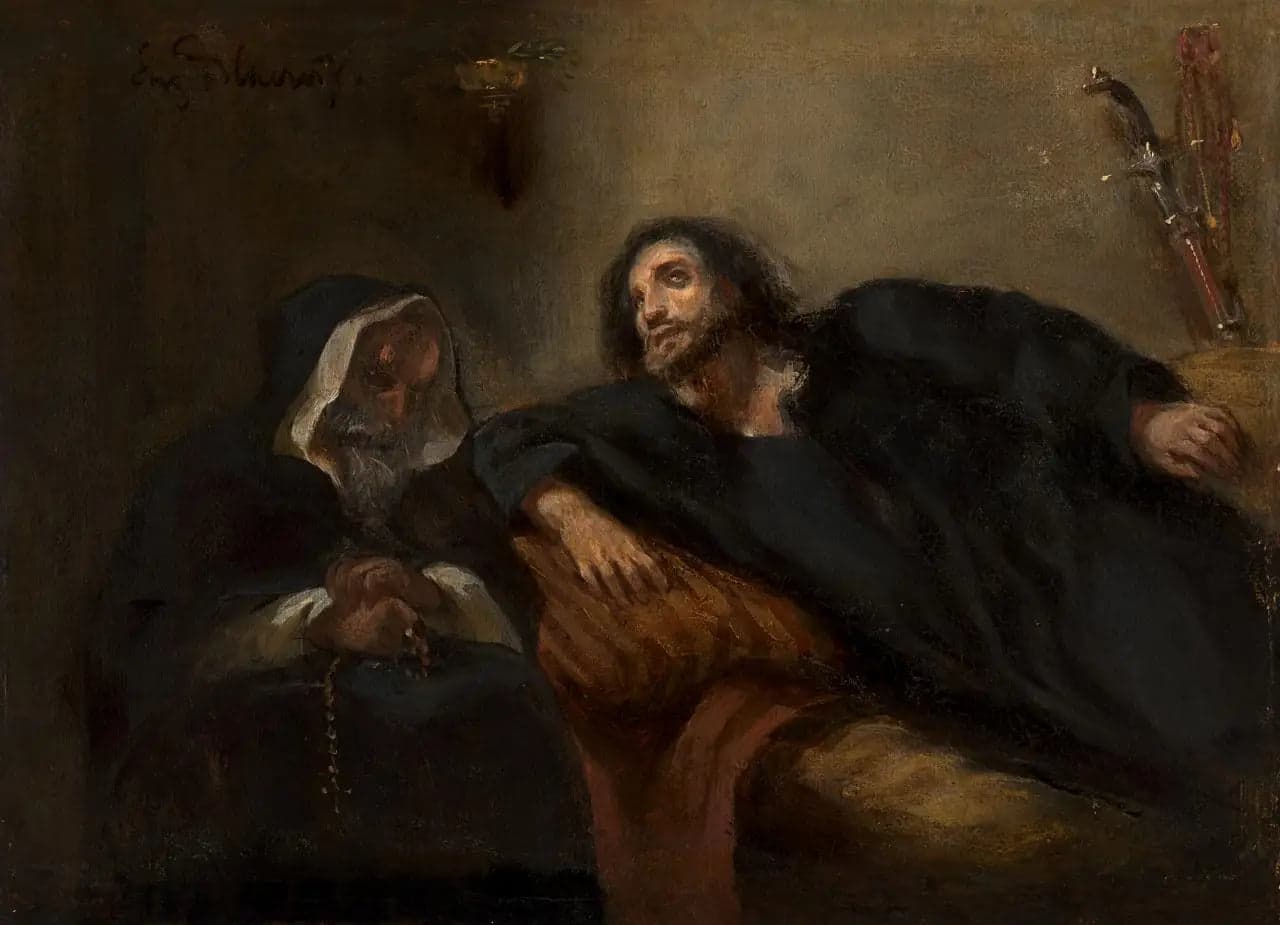
Confession of the Giaour
- Original dimensions
- 32.2 x 23.8 cm
- Museum
- National Gallery of Victoria
- Year
- 1832
Scene depicted
In this canvas , Delacroix captures the tormented soul of a man in search of redemption, caught in the turmoil of his conflicting feelings. The painting depicts a scene of intense passion where the struggle between love and despair comes to life, symbolizing the inner conflict that anyone can feel. Through his brushstrokes, the dramatic struggle and human fragility are highlighted, creating an atmosphere that is both heavy and sublime.
Historical context
Created in 1832, in romantic Paris, the painting "Confession of the Giaour" is part of the romantic movement, emblematic of a time when intense passions and human dramas were reinterpreted with renewed vigor. This canvas , currently housed in the National Gallery of Victoria , reflects a period when art sought emotion, rooted in a tumultuous socio-historical context. Its dimensions, 32.2 x 23.8 cm, make this piece a precious fragment of history, both personal and universal.
Place in the artist's career
The painting "Confession of the Giaour" marks a turning point in Delacroix's career, revealing his growing mastery of movement and light. Following other significant works from his creation, such as " Liberty Leading the People " and " The Massacre at Chios ", this work constitutes a stylistic peak, combining subtlety and power.
Anecdote
“All my life, I have sought to transcribe passion onto the canvas,” Delacroix said while reflecting on his work. One morning, when the golden light of a Parisian summer illuminated the Seine, he crossed paths with a desperate young man, his muted melancholy inspiring this unforgettable masterpiece . This painting draws its emotional roots from that fleeting moment, infusing the composition with a rare strength and delicacy.