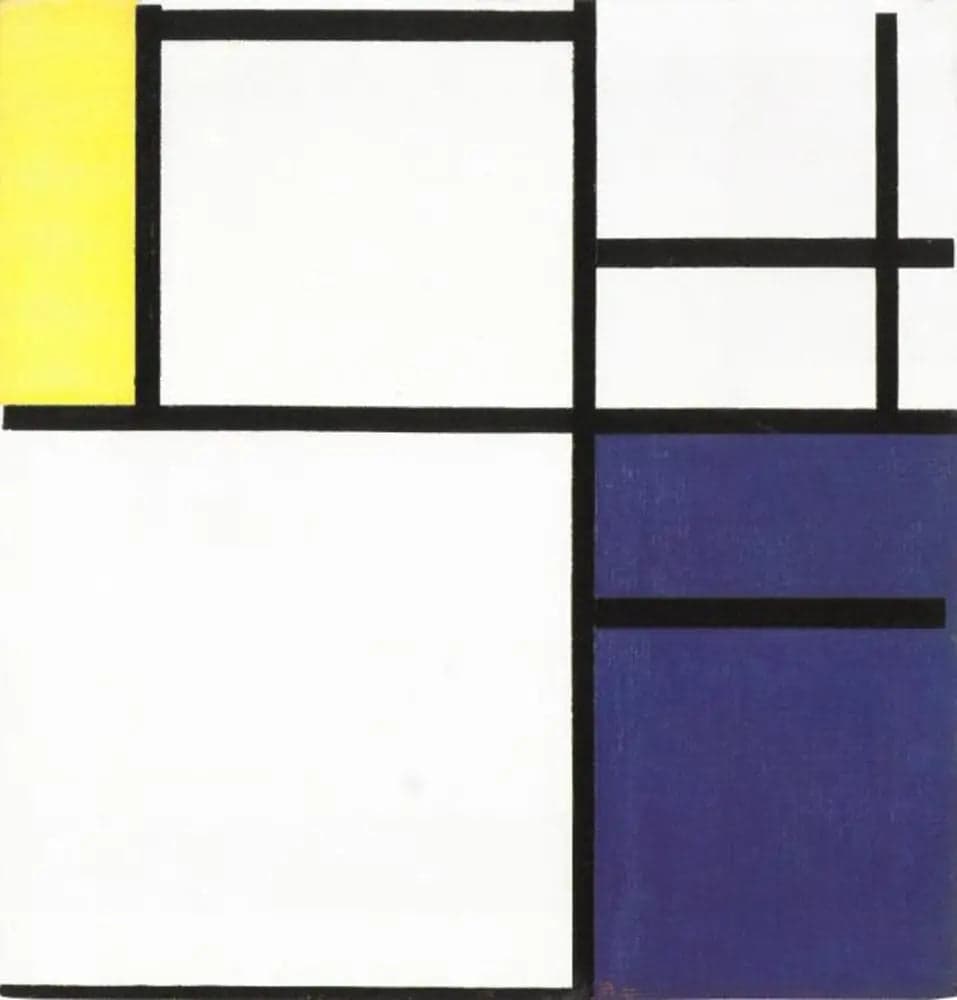
Composition with Yellow, Blue, and Blue-White
- Original dimensions
- 53.3 x 55.3 cm
- Museum
- Not specified
- Year
- 1922
Scene depicted
This pictorial work is characterized by juxtaposed rectangular shapes, vibrating with an internal dynamic. Using a minimalist visual language, Mondrian captures the essence of an interaction between primary colors and emptiness, creating a visual balance that is almost architectural. The painting is a true ode to the infinite possibilities offered by simplicity, each shade of yellow and blue conversing in a confined harmony, in a world where nature forms and composes.
Historical context
Year: 1922 |BRK| Museum: Not specified |BRK| Dimensions: 53.3 x 55.3 cm
Place in the artist's career
Positioned at the very heart of his career, this painting represents the pinnacle of Mondrian 's technique. Compared to his previous painting, “Composition in Red, Blue and Yellow,” where he experimented with shades, and “Tableau I,” which foreshadowed his characteristic style, this canvas marks an artistic maturity. The transition to pure abstraction and the quest for harmony are clearly palpable, revealing the emotional depth of his artistic journey.
Anecdote
“The true essence of reality must be captured in lines and colors.” These words resonate like a mantra for Mondrian who, on a spring morning, settled in his light-filled studio. The softness of the spring sun, filtered through the windows, made him realize that painting could be much more than a simple representation. It was in this inspiring atmosphere that the idea for this composition was shaped, a pivotal moment in the genesis of his masterpiece.