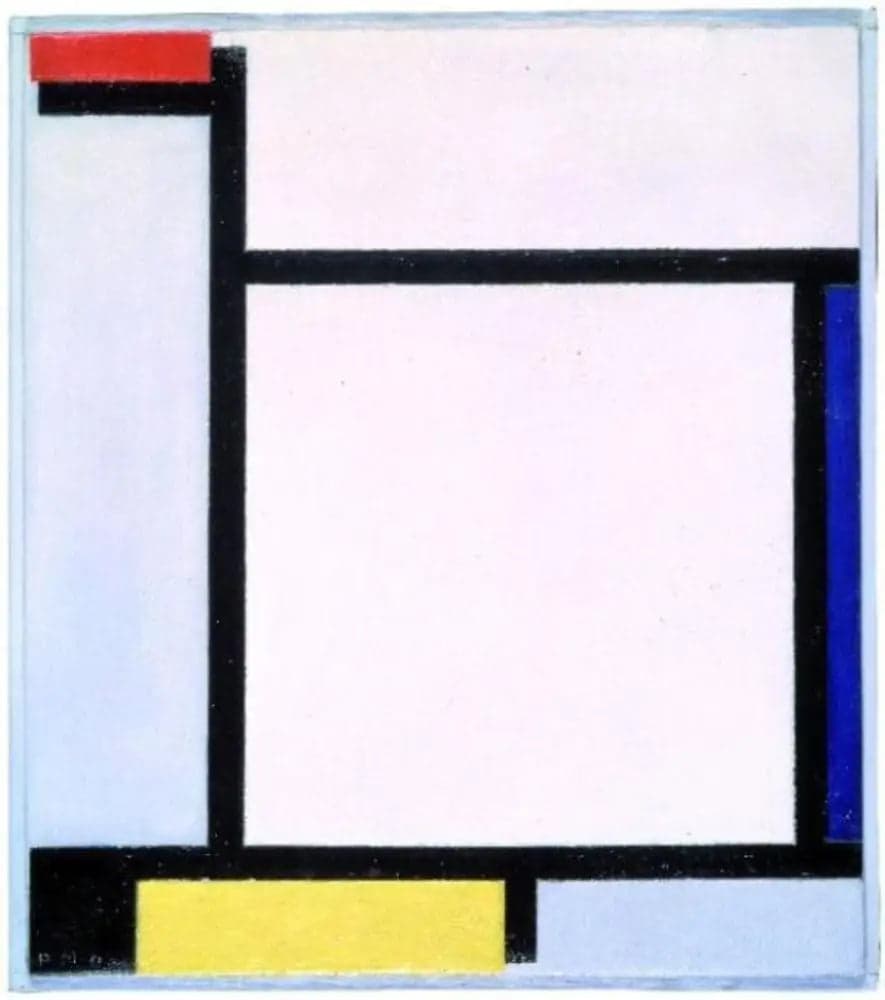
Composition with red, blue, black, yellow, and gray
- Original dimensions
- 35 x 39.5 cm
- Museum
- Museum of Art in The Hague
- Year
- 1921
Scene depicted
This canvas is a visual exploration of the relationships between primary colors and neutral shades. Mondrian questions the dynamics of geometric shapes in a space often perceived as static and ordinary, revealing the hidden beauty of simplicity and careful observation. The perfect balance between the color blocks vibrates with a quiet and determined energy, testifying to the artist's aspirations towards universal harmony.
Historical context
Year: 1921 |BRK| Museum: Museum of Art in The Hague |BRK| Dimensions: 35 x 39.5 cm
Place in the artist's career
Positioned at a crossroads, this painting represents a stylistic peak in the career of Mondrian . Indeed, preceded by works like “Tableau I” and followed by “Victory Boogie Woogie,” this pictorial work highlights the evolution of his mastery in composition and abstraction. A phase where his visual language refines, structured by a desire to reduce forms to their essence.
Anecdote
“The true essence of reality is in color and line,” is said to have declared Mondrian one day. On a beautiful morning in Paris, inspired by the lights reflecting on urban facades, he sketched the first outlines of this masterpiece . A meeting with the vibrant Parisian palette, full of life, that went beyond mere representation to embrace the very essence of existence.