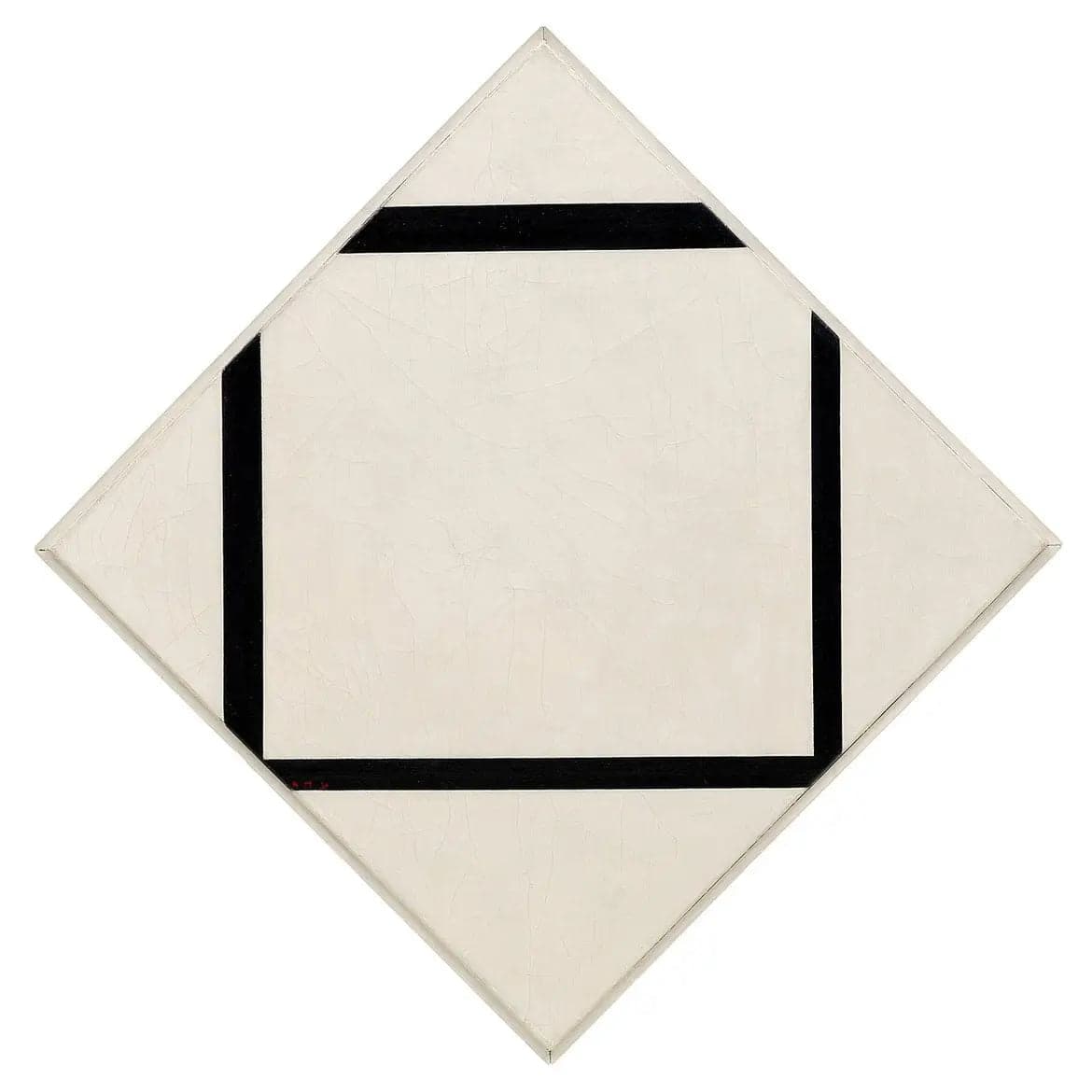
Composition No. 1: Diamond with Four Lines
- Original dimensions
- 107 x 107 cm
- Museum
- Solomon R. Guggenheim Museum
- Year
- 1930
Scene depicted
In this pictorial work, Mondrian explores the synthesis between geometric abstraction and a dynamic composition. The diamond, accompanied by four lines, becomes a symbol of universal harmony and balance. At the intersection of these lines, a palpable tension evokes the perpetual movement of life. This painting is not just a representation, but an invitation to reflect on the interaction between forms and space.
Historical context
Year: 1930 |BRK| Museum: Solomon R. Guggenheim Museum |BRK| Dimensions: 107 x 107 cm
Place in the artist's career
This painting fits into a significant period of Mondrian 's career, marking his transition to pure abstraction, a milestone in his artistic evolution. Alongside it, other paintings like 'Broadway Boogie Woogie' and 'Composition with Red, Blue and Yellow' illustrate a progression towards even bolder compositions. Thus, each painting testifies to his relentless desire to achieve a symbiosis between art and life.
Anecdote
“Simplicity is the key to truth,” said Mondrian , inspired during a walk through the bustling streets of Paris, where every street corner whispered to him an echo of the beauty hidden in the very structure of things. It was during one of those spring mornings that the idea for this composition came to him, each line and each color reflecting an infinite inner dialogue. This emotion is deeply felt in the painting, where each stroke stands as a note of a visual melody.