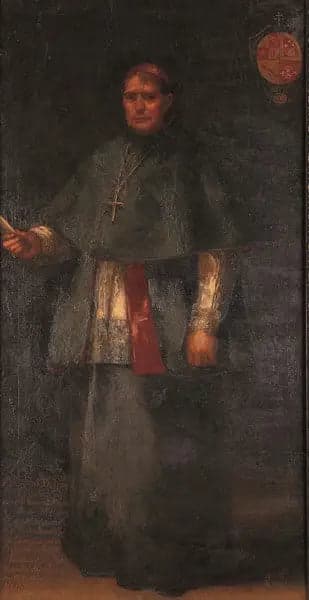
Company of Archbishop Joaquin
- Original dimensions
- 59 x 74 cm
- Museum
- Alma Mater Museum
- Year
- 1800
Scene depicted
In the painting “Compagnie de l'archevêque Joaquin,” Goya takes us into a world where spirituality and reality intertwine. The work presents prominent characters in a solemn posture, marking a moment of devotion, while their warm expressions betray the depth of their interactions, rooted in the social and religious context of their time.
Historical context
Created in 1800, during the vibrant Spanish era, Goya's painting embodies the romantic movement emerging from the shadow of the Enlightenment. This canvas , currently displayed at the Alma Mater Museum, resonates with the echo of the paradoxes of a changing society. It subtly captures the breath of an era where emotion takes precedence over reason, while displaying dimensions of 59 x 74 cm that invite intimate contemplation.
Place in the artist's career
This canvas is situated at a decisive turning point in Goya's career. From the innocent candor of his youthful works to the emotional depth of his later canvases, “Compagnie de l'archevêque Joaquin” reads through the light a passage to his maturity. Echoing “La Maja Desnuda” and “Les Désastres de la Guerre,” this painting reveals his artistic evolution, where each brushstroke becomes a touching confession.
Anecdote
“I paint not only what I see, but also what I feel.” In an alley in Madrid, one spring morning, the artist encounters a group of draped figures, a symbol of religious nobility. This fleeting moment drives him to capture the essence of a society, nourishing this pictorial work , truth and beauty intertwined, in a burst of light and shadow.