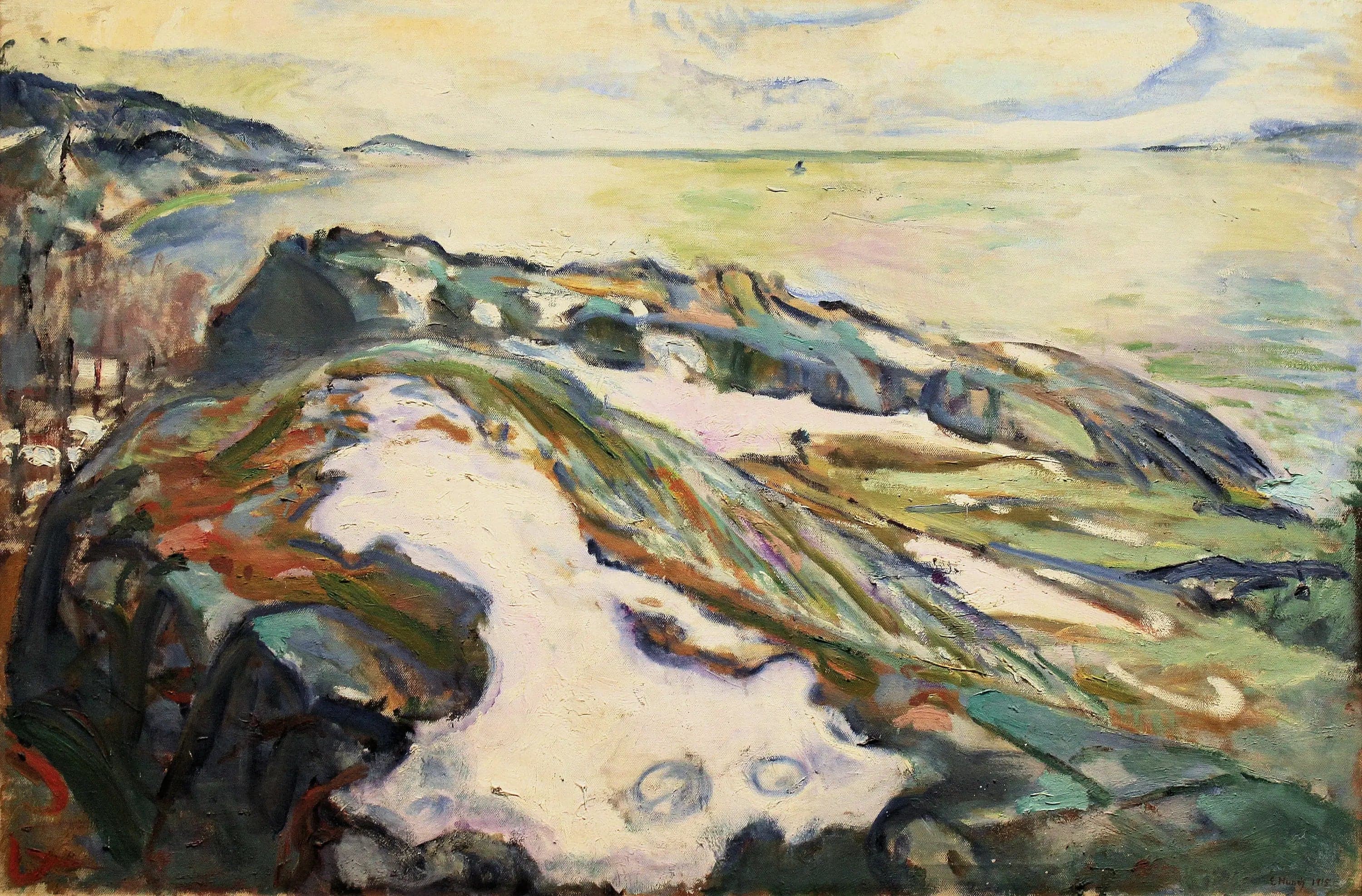
Coastal Landscape of Hvitsten
- Original dimensions
- 100 x 74 cm
- Museum
- Not specified
- Year
- 1922
Scene depicted
The painting "Coastal Landscape of Hvitsten" depicts a serene scene of the Norwegian coastline, where the gentleness of the waves meets the warmth of the setting sun. The fluid hues of the water, the silhouettes of distant hills, and the peaceful atmosphere invite delicate contemplation. This painting unfolds a natural beauty while resonating with universal emotions, such as melancholy and nostalgia, characteristic of Munch's work.
Historical context
Created in 1922, the painting "Coastal Landscape of Hvitsten" transports us to the picturesque village of Hvitsten, located on the Norwegian coast. This masterpiece is part of the symbolism movement, where Munch seeks to capture the essence of human emotion through the surrounding landscapes. Created during a pivotal time in the artist's artistic development, this painting reflects his commitment to the sensitive world around him. Currently, this painting remains in the shadows of private collections, but its visual impact endures in the minds of art lovers.
Place in the artist's career
Coastal Landscape of Hvitsten is situated at the heart of Edvard Munch 's artistic maturity period. This painting marks a turning point in his exploration of landscapes, following his iconic works such as "The Scream" and "The Madonna." While these paintings express intense emotions, this one conveys a sense of peace and redemption, revealing a Munch in full evolution, both technically and emotionally.
Anecdote
Edvard Munch , on a sunny morning in Norway, stated: "Nature speaks to those who know how to listen." It was by exploring the serenity of Hvitsten that he drew inspiration for this masterpiece , immortalizing not only a landscape but also a deep emotion through each brushstroke. In this moment of introspection, Munch was able to transform a simple painting into a true reflection of the human soul.