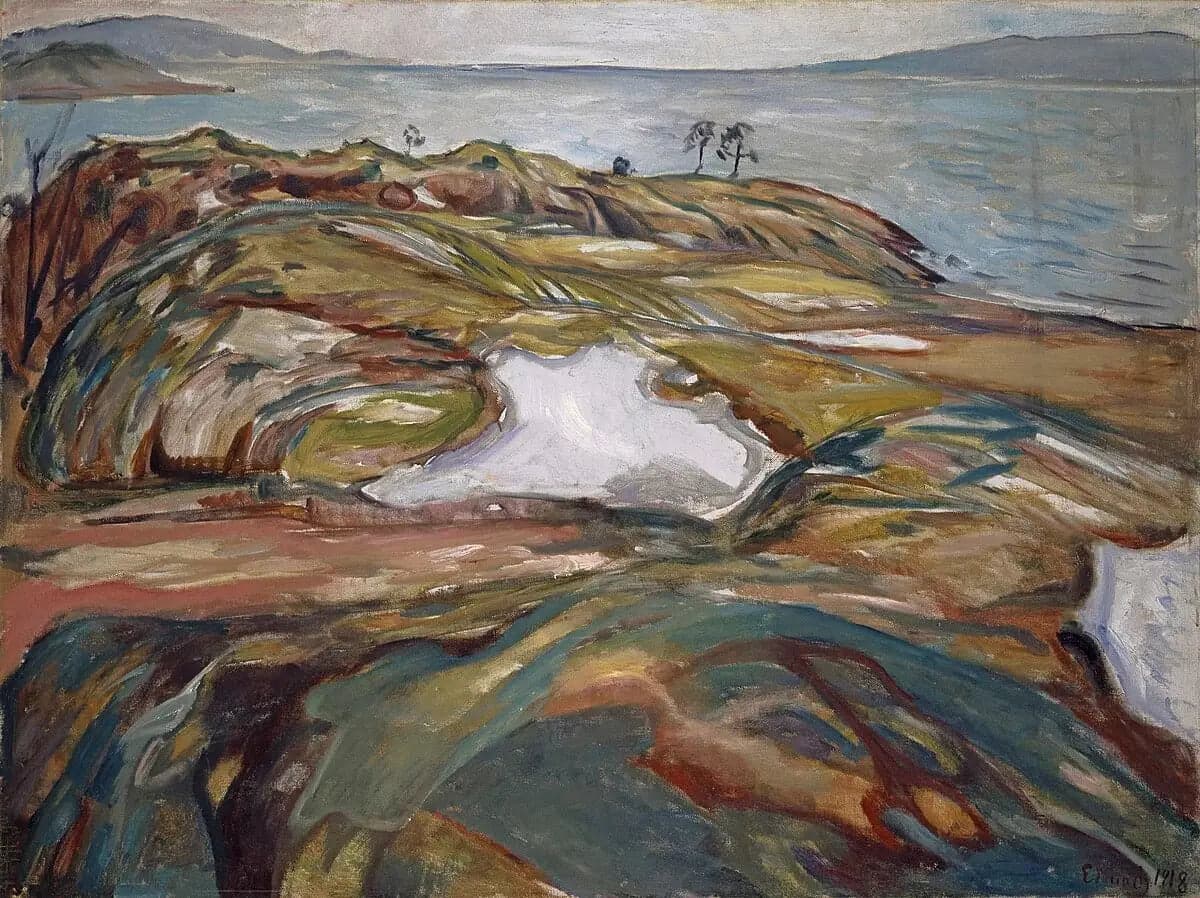
Coastal Landscape
- Original dimensions
- 160.5 x 121 cm
- Museum
- Kunstmuseum Basel
- Year
- 1918
Scene depicted
The canvas “Coastal Landscape” depicts a beautifully rhythmic marine scene where the sea meets the shore. The aquatic hues that dance on the canvas evoke the tranquility of an afternoon by the sea, revealing the inner turmoil of the artist. The composition is characterized by a freedom of movement, with waves that seem to vibrate with life, all set against a captivating backdrop.
Historical context
Created in 1918, during a tumultuous period in Europe, this iconic painting by Edvard Munch is part of the expressionist movement, an artistic current that seeks to translate human emotions through color and form. The painting currently resides at the Kunstmuseum in Basel, an institution recognized for its rich collection of modern works. With its imposing dimensions, this painting evokes both the grandeur of nature and the intensity of human feelings.
Place in the artist's career
In his career, Coastal Landscape represents a stylistic peak for Munch. It belongs to a period where his work transcended mere landscape to question human emotions. When compared to other paintings like “The Scream” and “The Madonna,” one can appreciate his evolution as an artist exploring the depths of the human soul through painting.
Anecdote
Munch once stated: “In nature, there is a truth that can only be expressed through art.” This reflection guided his hands during the creation of this masterpiece. Imagine a morning, where the sky is tinted with pastel shades and the gentle whisper of the waves inspires him with an irresistible urge. It is in this natural setting, filled with emotions, that the composition of Coastal Landscape came to life.