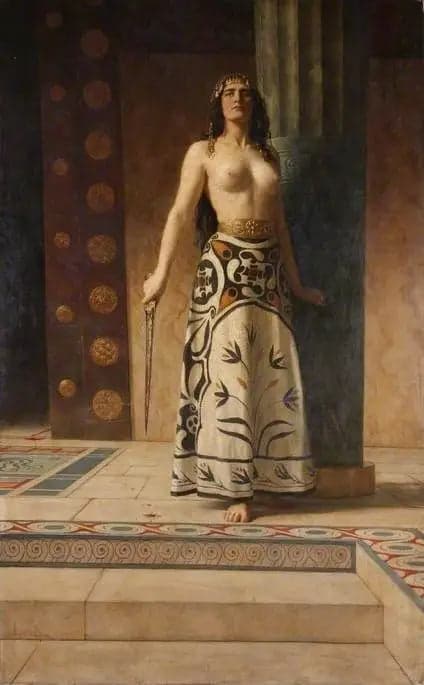
Clytemnestra
Scene depicted
This painting depicts Clytemnestra, a tragic mythological figure, in a posture that evokes both power and despair. Her gaze, filled with pain, tells us the story of a queen devastated by betrayal and vengeance, creating a palpable tension between the beauty of the composition and the underlying tragedy of her narrative.
Historical context
The painting "Clytemnestra" was created in 1893, in London, at the heart of the Victorian era, a time when realism and Pre-Raphaelitism intertwined to give birth to exceptional pictorial works. This canvas now preserved at the Tate Britain embodies the essence of this artistic movement, celebrating the beauty and tragedy of mythological narratives.
Place in the artist's career
"Clytemnestra" is a pivot in Collier's career, marking his transition to remarkable artistic maturity. In parallel, his works "The Last Supper" and "The Death of Cleopatra" show a technical evolution, particularly through the bold use of light and shadow to amplify emotions. This canvas thus fits into a journey where the composition, both rigorous and lyrical, reveals the richness of storytelling.
Anecdote
"The greatest beauty can often be found in pain," is said to have declared John Collier during the creation of this masterpiece. Imagine an autumn morning, where the sweet scent of fallen leaves mingles with the golden light filtering through the branches. This moment of grace and melancholy inspired the artist in his quest to capture the tormented soul of Clytemnestra.