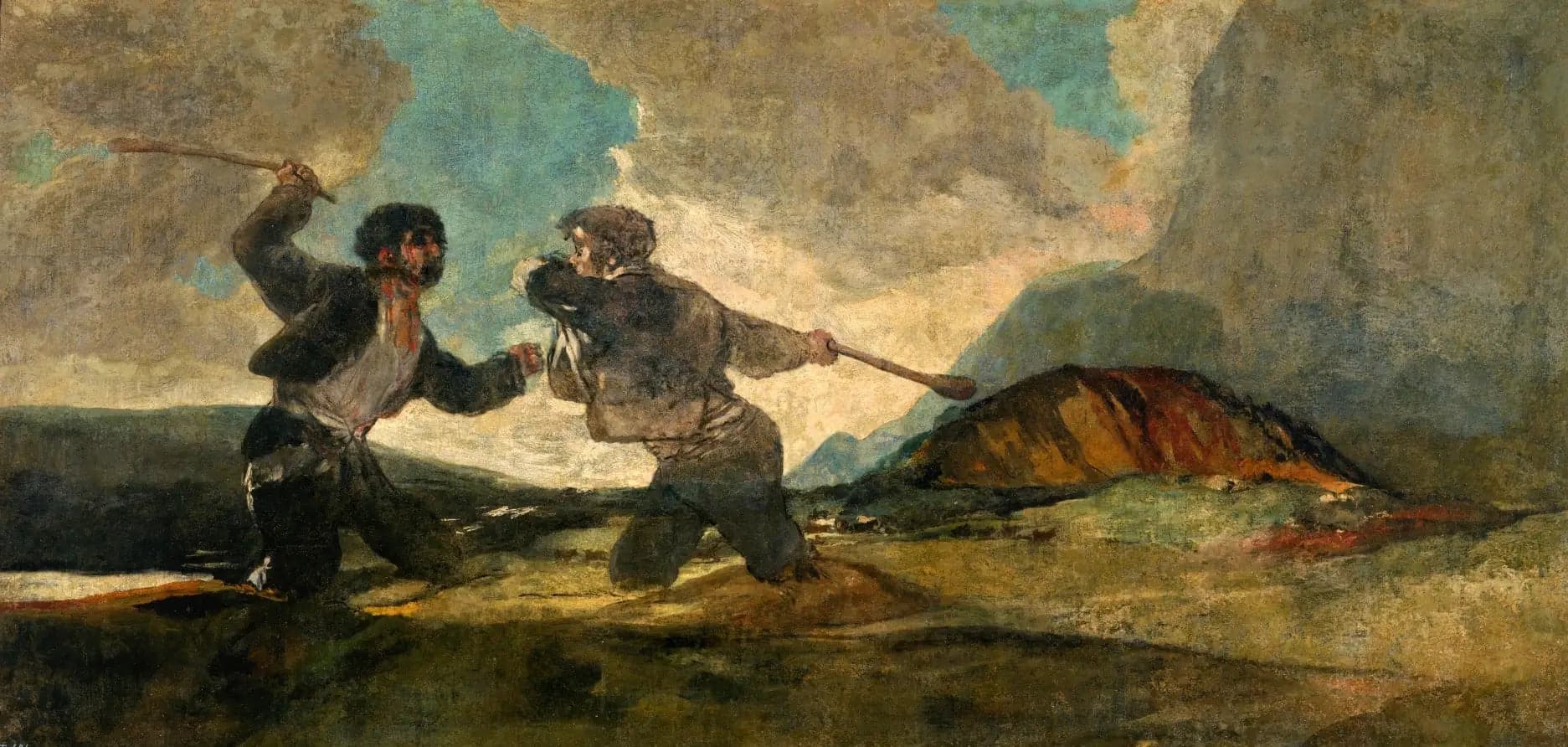
Club Fight
- Original dimensions
- 261 x 125 cm
- Museum
- Museo del Prado
- Year
- 1820
Scene depicted
The painting “Duel au gourdin” illustrates an intense struggle between two men armed with clubs. This canvas represents more than just a physical confrontation: it symbolizes a clash of wills, a dichotomy between power and resistance. The palpable energy within this scene, where every detail seems to vibrate, reveals Goya's talent for transcending mere representation to touch on the truth of human emotions.
Historical context
This painting emblematic, created in 1820, is the result of the genius of Francisco de Goya , a leading artist of the Spanish romantic movement. In the tumultuous atmosphere of post-Napoleonic Spain, Goya captures the essence of a struggle and a human confrontation through this canvas , which is currently housed in the prestigious Museo del Prado in Madrid. The impressive dimensions of this pictorial work enhance its visual impact and depth.
Place in the artist's career
This canvas , from a mature period of Goya's career, is part of a series of works that explore the themes of violence and human suffering. Alongside other masterpieces such as “The Executions of the Third of May” and “Saturn Devouring a Son,” this painting illustrates the stylistic evolution of the artist, moving towards a darker and more psychological technique.
Anecdote
“Every brushstroke is a cry of the soul,” Goya might have said while observing the animation of a duel in an isolated square in Madrid. On a misty morning, charged with electricity in the air, he would have captured the emotional intensity of this scene to immortalize this moment, revealing the ardor and inherent violence of man through his painting .