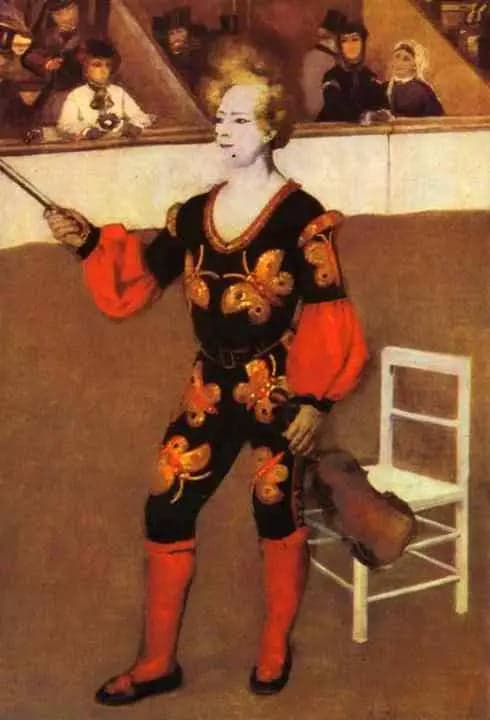
Clown at the Circus - Pierre
- Original dimensions
- 130 x 193.5 cm
Scene depicted
In Clown au cirque , Renoir captures a privileged moment of circus life. A clown, representing joy and innocence, emerges from a blurred background, his graceful and expressive gestures attracting the audience's attention. Around him, the brilliance of dazzled faces and the vibrant colors of a fair evoke a happy childhood, conjuring an atmosphere where laughter and spectacle could coexist freely.
Historical context
Œuvre : Clown au cirque |BRK| Artiste : Auguste Renoir |BRK| Année : 1868 |BRK| Musée : musée Kröller-Müller |BRK| Dimensions : 130 x 193.5 cm |BRK|
Place in the artist's career
Clown au cirque is a significant milestone in the career of Auguste Renoir , embodying both his sense of color and his understanding of form. This painting is strategically situated between his early Impressionist works, visible in Ballet au Moulin de la Galette , and his mature works such as Les baigneuses . It testifies to Renoir's technical evolution, where light becomes a protagonist, sculpting silhouettes and nourishing expression.
Anecdote
"I seek in my paintings to capture what I feel deep within me," Renoir might have said one spring morning, as a light breeze brought the sounds of children's laughter and the scent of sweets from the circus. This pictorial work is the fruit of this quest, at the very heart of Parisian effervescence, a vibrant tribute to the joy of living and fleeting beauty.