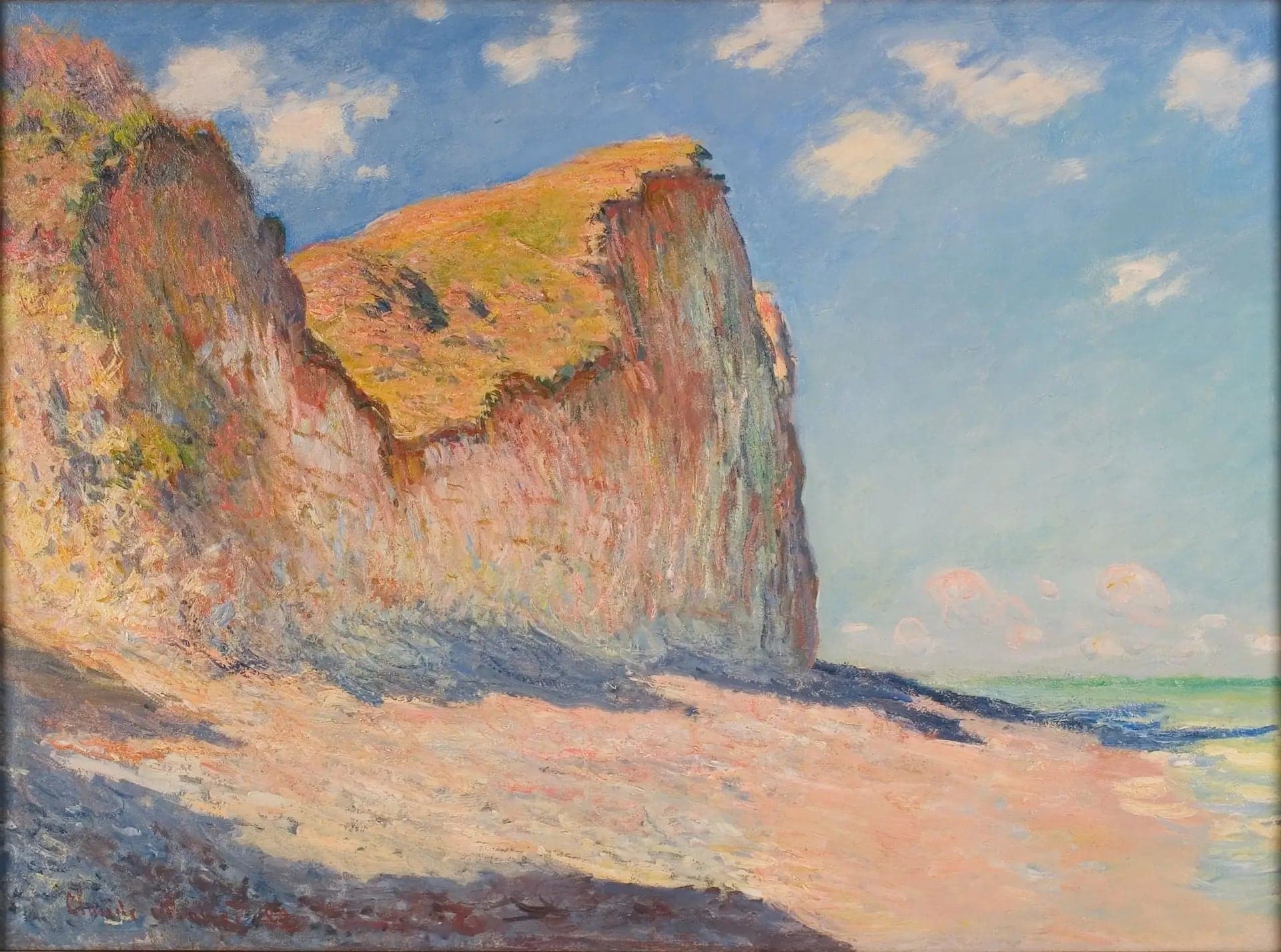
Cliffs near Pourville
- Original dimensions
- 80.9 x 60.4 cm
- Museum
- Rijksmuseum Twenthe
- Year
- 1882
Scene depicted
In this painting, the majestic white cliffs, sculpted by time, stand out majestically against a sky imbued with subtle hues. The waves gently crash at the foot of these rock formations, while the light plays on the surfaces, creating an almost ethereal atmosphere. Monet, with his sharp eye, composes a captivating scene, which has become an emblem of the natural wonders of Normandy.
Historical context
Year: 1882 |BRK| Museum: Rijksmuseum Twenthe |BRK| Dimensions: 80.9 x 60.4 cm
Place in the artist's career
“Cliffs near Pourville ” marks a pivotal period in Monet's career, where he sharpens his Impressionist style. This painting, alongside other works like “ Impression, Sunrise ” and “ The Cathedral of Rouen ”, shows his evolution towards an increasingly bold technique, capturing light and atmosphere with unprecedented intensity. It is a turning point that reinforces his reputation as a pioneer in the art world.
Anecdote
“I paint like a musician composes.” This quote from Claude Monet evokes how a soft, misty morning in Pourville inspired the artist. It is there, on the beach, that the nuances of light danced on the cliffs, revealing a symphony of colors that Monet immortalized in his canvas. Each brushstroke then becomes a vibrant note of the painting , seeking to capture the fleeting essence of nature.