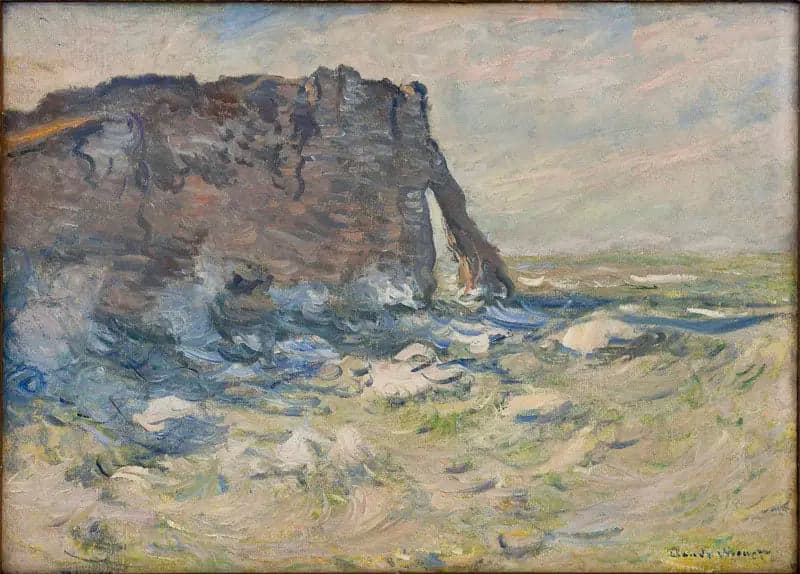
Cliff and Aval Door in Rough Weather
- Original dimensions
- 100 x 73 cm
- Museum
- Montserrat Museum
- Year
- 1883
Scene depicted
In this fascinating canvas, Monet depicts the majesty of the cliffs of Etretat , where the natural arch carved by the sea rises, a flaming parasol under the embers of the tumultuous skies. The waves, agitated by the violent wind, crash against the rocks, creating a visual symphony of white and blue. This work represents not only a landscape but an intense dialogue between the artist and nature, where each brushstroke breathes the raw energy of the marine element.
Historical context
Year: 1883 |BRK| Museum: Montserrat Museum |BRK| Dimensions: 100 x 73 cm
Place in the artist's career
Falaise and Porte d'Aval in Stormy Weather is part of a period where Claude Monet explores the limits of his art. This painting, alongside ** Impression, Sunrise ** and ** Water Lilies **, testifies to his technical and emotional evolution. It is during this time that Monet refines his mastery of shades and light, revealing an increased sensitivity to natural landscapes. This painting is not only a highlight of his career but also a testament to an unending quest for harmony through art.
Anecdote
“Nature is my true master,” said Monet. The inspiration for this painting came to him during an unexpected storm on the coast, one morning when the smell of sea salt mingled with the cries of seagulls. This moment of thrill in the face of the elements infused explosive strength into the composition of the canvas, capturing the intensity of nature at its peak. The **painting** trembles with emotions, vibrant like a melody of the wind haunting the shore.