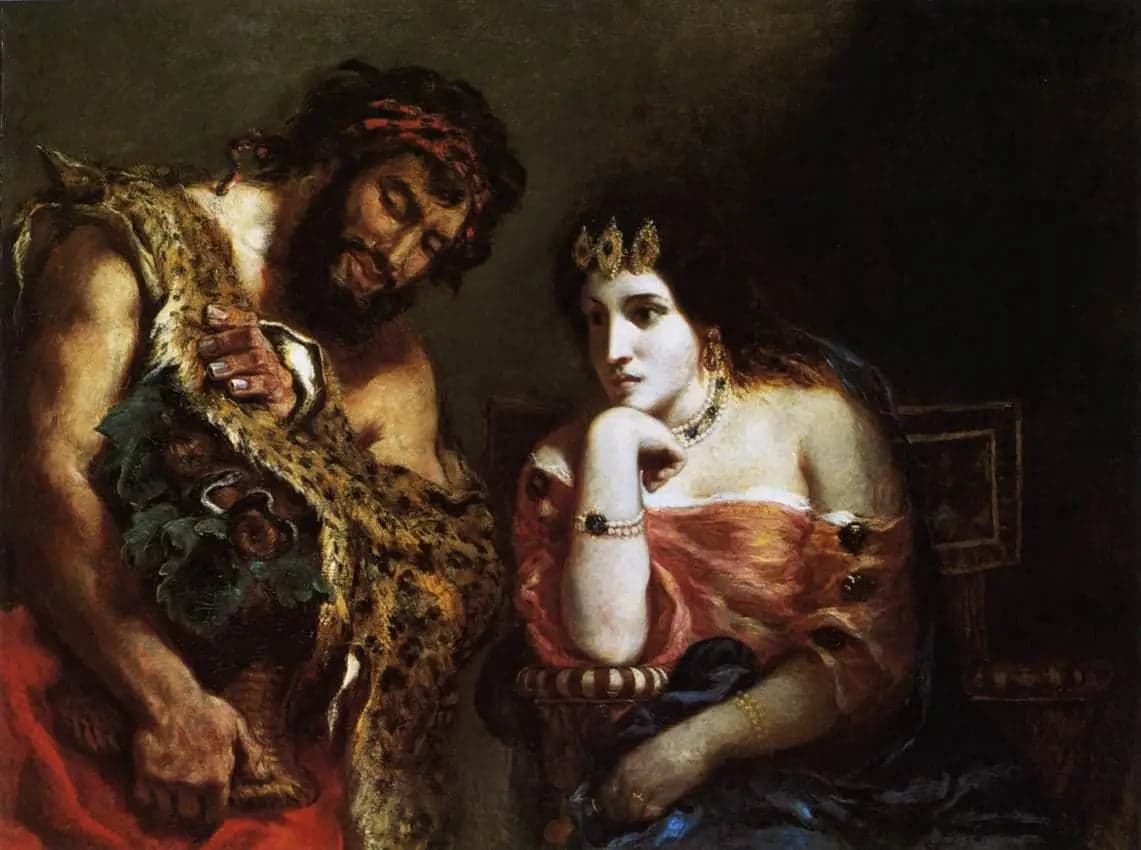
Cleopatra and the Peasant
- Original dimensions
- 127 x 97.8 cm
- Museum
- Ackland Art Museum
- Year
- 1838
Scene depicted
In this painting , we witness a poignant encounter between Cleopatra and a peasant, illustrating the juxtaposition of worlds. The grace and majesty of the queen, tinged with sadness, are contrasted by the disarming simplicity of the common man. This painting tells not only a story of encounter but also one of the impossible communication between social classes, while immersing the viewer in an atmosphere of tension and poetry.
Historical context
Artwork: Cleopatra and the Peasant |BRK| Artist: Eugène Delacroix |BRK| Year: 1838 |BRK| Museum: Ackland Art Museum |BRK| Dimensions: 127 x 97.8 cm |BRK| Major Exhibitions: Salon of 1839 |BRK|
Place in the artist's career
"Cleopatra and the Peasant" is situated at a characteristic turning point in Delacroix's career, a period of full stylistic maturity. It can be paralleled with other paintings such as " Liberty Leading the People " and " The Massacres of Scio ", where he examines the human soul with increasing intensity, reflecting a technical evolution nourished by a deep emotional commitment.
Anecdote
Delacroix once said: "In every painting, I seek a hidden truth." His inspiration for this pictorial work may have emerged around a Parisian alley one spring morning, when the first light of day danced on the cobblestones, evoking in him the fragile beauty of the moment. This vivid emotion is reflected in the evocative power of the painting .
Major exhibitions
Salon of 1839