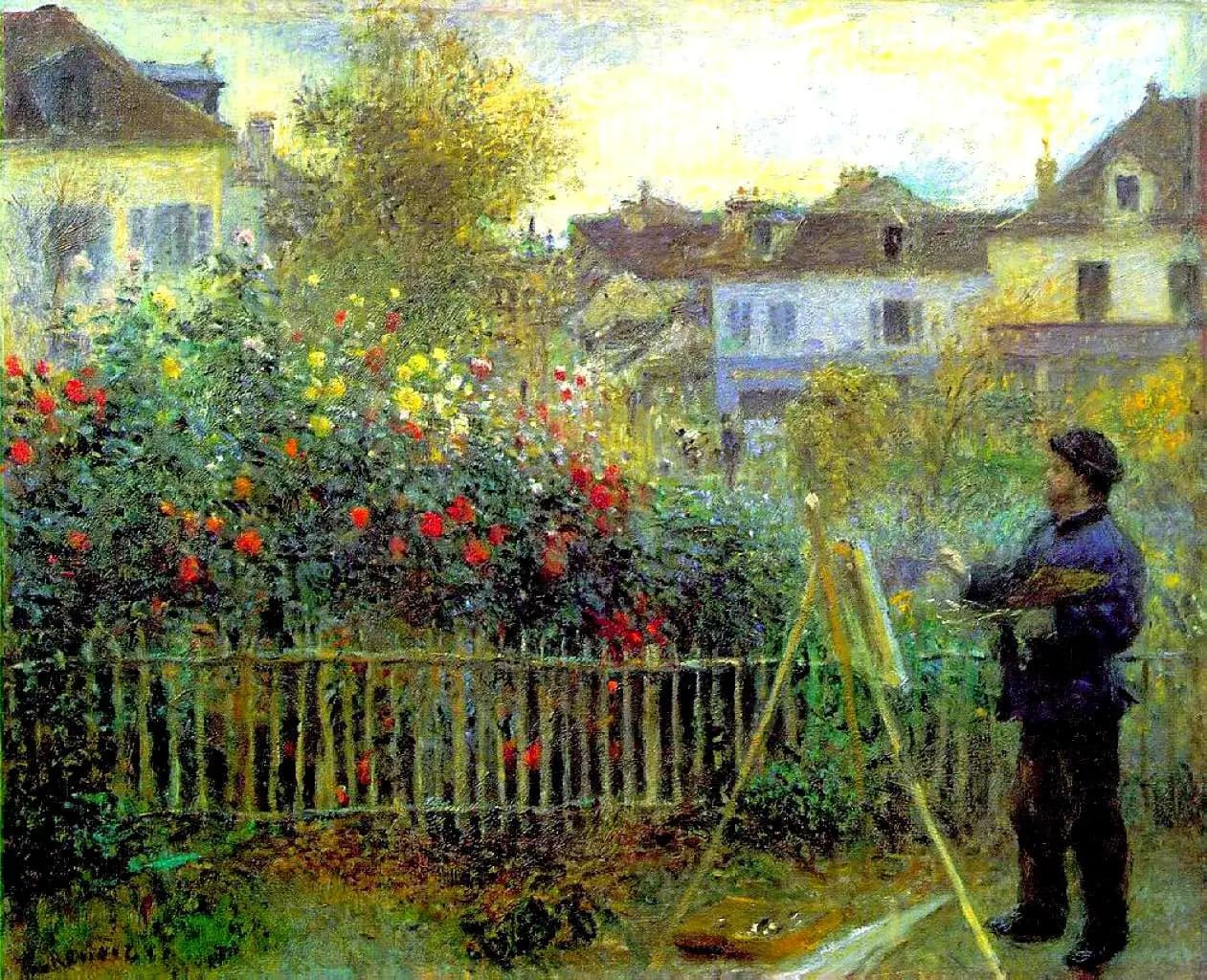
Claude Monet painting in his garden at Argenteuil - Pierre
- Original dimensions
- 60 x 46 cm
- Museum
- Wadsworth Atheneum
- Year
- 1873
Scene depicted
The canvas “Claude Monet painting in his garden in Argenteuil” presents the famous painter in the act of creation, surrounded by his lush garden. This vibrant composition illustrates the Impressionist dream, where colors burst and dance under the rays of the sun, evoking the living energy camouflaged in every leaf and every petal. Monet, armed with his brush, creates his canvas, thus testifying to the ephemeral moment and the fleeting beauty of the natural world.
Historical context
This painting , created in 1873 in the charming town of Argenteuil, perfectly illustrates the spirit of the Impressionist movement that was emerging at that time. In a setting bathed in sunlight, Monet, this master of shades, immortalizes a snippet of a magnificent moment, where nature intertwines with art. The canvas is currently housed within the prestigious Wadsworth Atheneum , immersing visitors in a harmonious dialogue between past and present.
Place in the artist's career
This masterpiece fits into a fascinating period of Auguste Renoir 's career. Both a composition of tenderness and boldness, “Claude Monet painting in his garden in Argenteuil” adds to other remarkable canvases such as “Luncheon of the Boating Party” and “The Large Bathers,” revealing an evolution marked by a deep exploration of luminosity and emotional dimensions, while foreshadowing the creative maturity of the artist.
Anecdote
Auguste Renoir once declared: “Capturing a moment in light is a challenge, but oh! the reward is eternal.” Inspired by the softness of a spring morning, as a gentle breeze caresses the flowers, Renoir captures this scene of an artist at work, enjoying the brilliance of nature in full bloom. This painting resonates with this pure emotion, embodying the symbiosis between creativity and the natural environment.