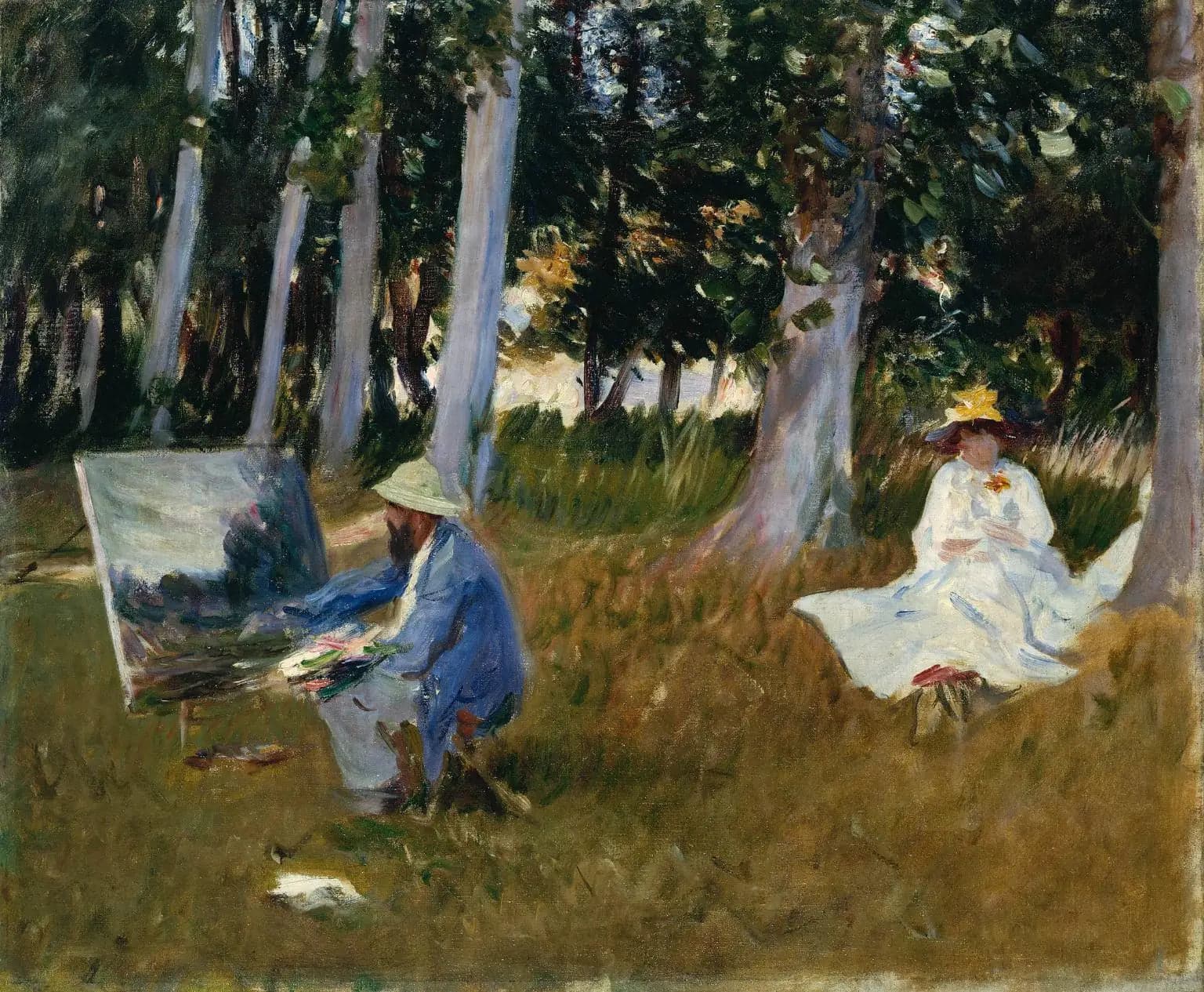
Claude Monet painting at the edge of a wood
- Original dimensions
- 54 x 64.8 cm
- Museum
- Tate
- Year
- 1885
Scene depicted
In this canvas , Sargent does not just capture a scene, but the very soul of art. The artist focused on representing Monet, a witness to the opulent nature, bent over his easel, his artistic vision merging with the surrounding greenery. This painting is not just a simple representation; it is an invitation to admire a delicate sketch of the creative process, where the outside world merges with the inner universe of the artist.
Historical context
This painting , created in 1885, is nestled in the impressionist movement, in London, where the artist John Singer Sargent managed to capture a memorable moment. Claude Monet painting at the edge of a wood represents a crossing of influences and artistic traditions, drawing its roots from the vibrant atmosphere of the late 19th century. Today, this canvas radiates within the collections of the Tate , echoing the creative spirit of that era.
Place in the artist's career
Inscribed among Sargent's great works, Claude Monet painting at the edge of a wood is situated at a turning point in his career, revealing a maturity in his art. In parallel with The renting of bicycles in Venice and Portrait of Madame X , this painting displays an evolution towards light and a stylistic renewal, demonstrating his ability to combine the figurative and the impressionist with mastery.
Anecdote
“In every brushstroke, I try to capture the ephemeral beauty of light.” This quote from Sargent resonates particularly when discussing the moment of the creation of Claude Monet painting at the edge of a wood . Fleeting inspiration, born from a morning with soft golden rays, this painting evokes the sensations of a fresh spring, with floral scents and the song of birds, elevating the work to the rank of a true masterpiece.