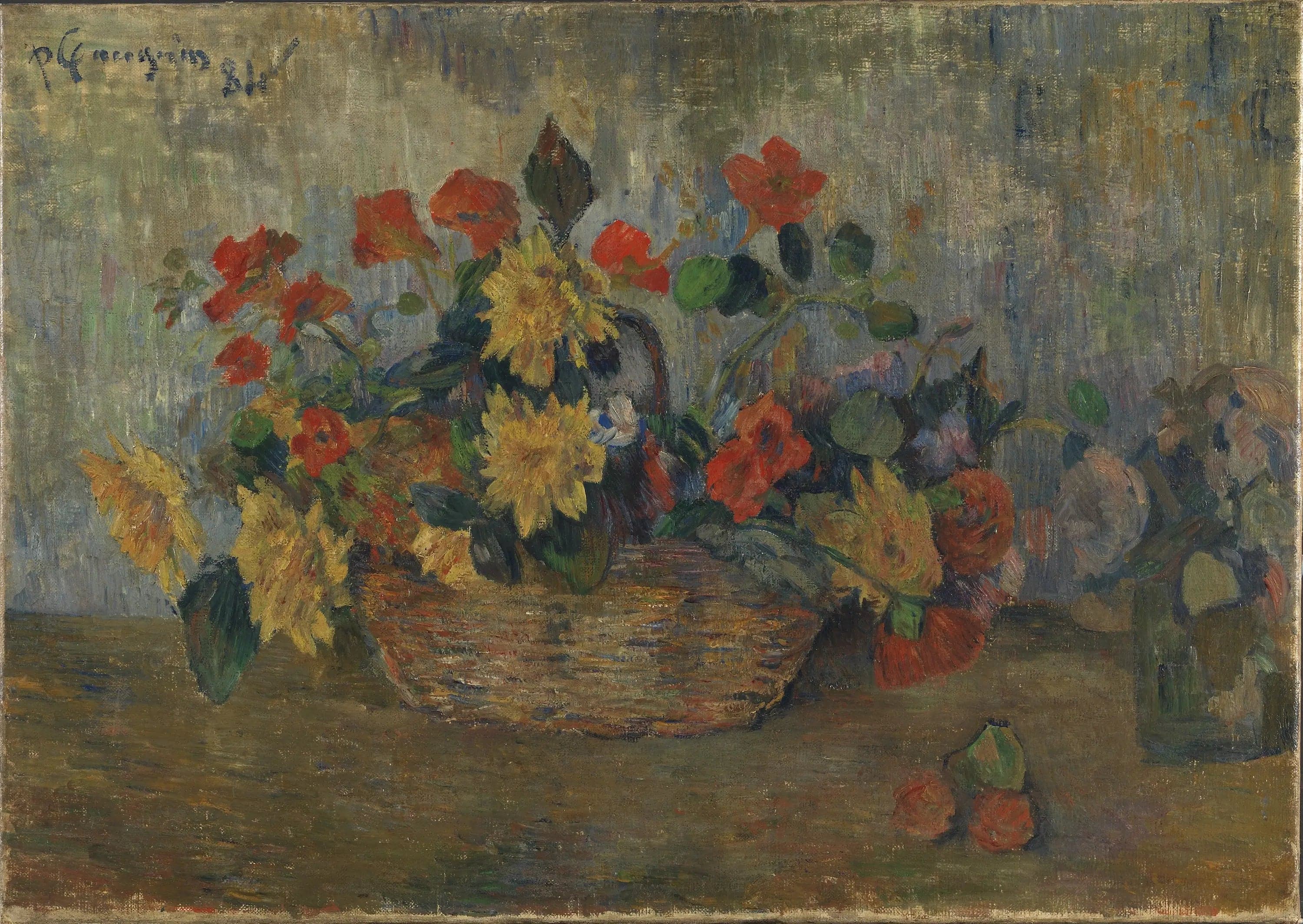
Cinerarias and Dahlias in a Basket
- Original dimensions
- 65 x 46 cm
- Museum
- National Museum
- Year
- 1884
Scene depicted
The canvas “Nasturtiums and Dahlias in a Basket” illustrates a harmonious composition, where warm-hued nasturtiums blend with the magnificence of dahlias, reflecting Gauguin's passion for nature. With an almost naive approach, the artist manages to transcend simple floral representation to create an ode to life, a celebration of the timelessness of natural beauty.
Historical context
Created in 1884, this painting is an iconic work of the Post-Impressionist movement, originating in Pont-Aven, a charming commune located in Brittany, France. It is in this vibrant artistic setting that the canvas was born, as Gauguin sought to express his deep connection with nature and depict the fleeting beauty of flowers. Currently, the work is carefully preserved at the National Museum, where it continues to fascinate visitors with its rich composition and vibrant colors.
Place in the artist's career
This masterpiece is a pivotal moment in Gauguin's career, marking the beginning of his quest for a unique style. While his earlier works, such as “Vision After the Sermon,” already laid the groundwork for his pictorial language, “Nasturtiums and Dahlias” foreshadows his bolder period in Tahiti. One can sense a technical maturation here, a prelude to his great emotional explorations.
Anecdote
“I wanted to capture the ephemeral in these flowers, to share a moment of life...,” Gauguin expressed one bright morning while observing his garden. It was during these moments of inspiration, in the heart of a spring woven with floral scents, that this masterpiece took shape, a canvas that evokes both beauty and melancholy.