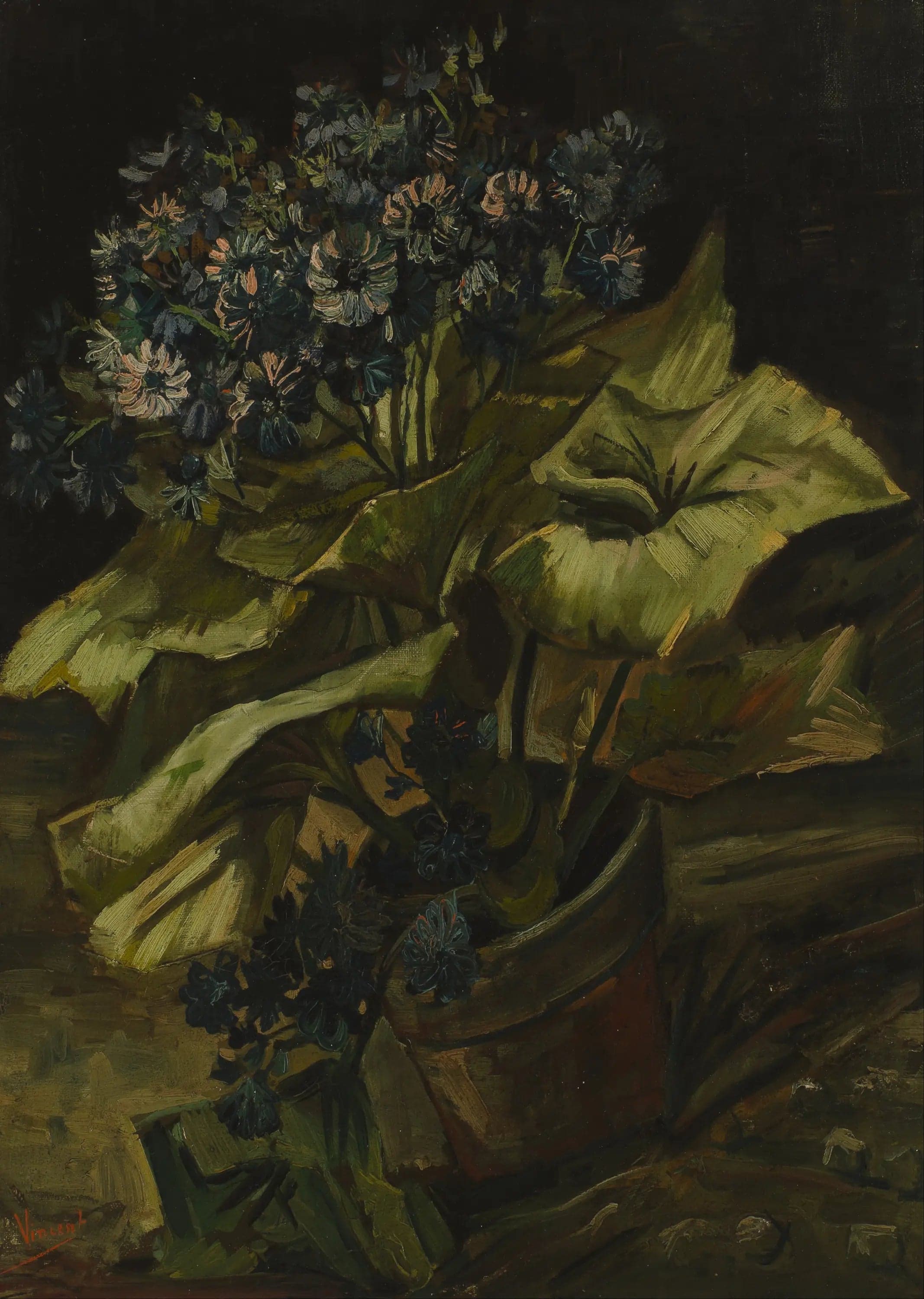
Cinéraire
- Original dimensions
- 46 x 54.5 cm
- Museum
- Boijmans Van Beuningen Museum
- Year
- 1886
Scene depicted
In Cinéraire , Vincent van Gogh immerses us in a serene ambiance, where the cemetery takes on a contemplative air. The painting reveals a dense and poetic composition, where the flowers , often associated with death, become a symbol of ephemeral beauty. The way he plays with shapes and shadows brings this pictorial work to life, provoking in the viewer a reflection on the natural cycle of life and death.
Historical context
Created in 1886 in Paris , amidst the excitement of the post-impressionist movement, Cinéraire is an iconic canvas that embodies the tormented soul of its creator. At that time, Vincent van Gogh deeply explores colors and shapes, seeking to capture the very essence of life. Today, this painting is located at the Boijmans Van Beuningen Museum , where it fascinates visitors with its expressive strength and profound humanity.
Place in the artist's career
Cinéraire marks a crucial step in the career of Vincent van Gogh , representing a period where he reaches exceptional stylistic maturity. Compared to other paintings such as The Sunflowers and The Starry Night , this painting testifies to his evolution in the use of color and texture, fruits of deep introspection.
Anecdote
“I want to make visible what I feel,” Vincent said while painting. Imagine him, at the dawn of a spring morning, strolling through the streets of Paris . A soft light reflects on the walls, and the scent of flowers fills the air. It is in this atmosphere charged with emotions that he draws inspiration for his masterpiece , Cinéraire , a work that speaks of life and melancholy through every brushstroke.