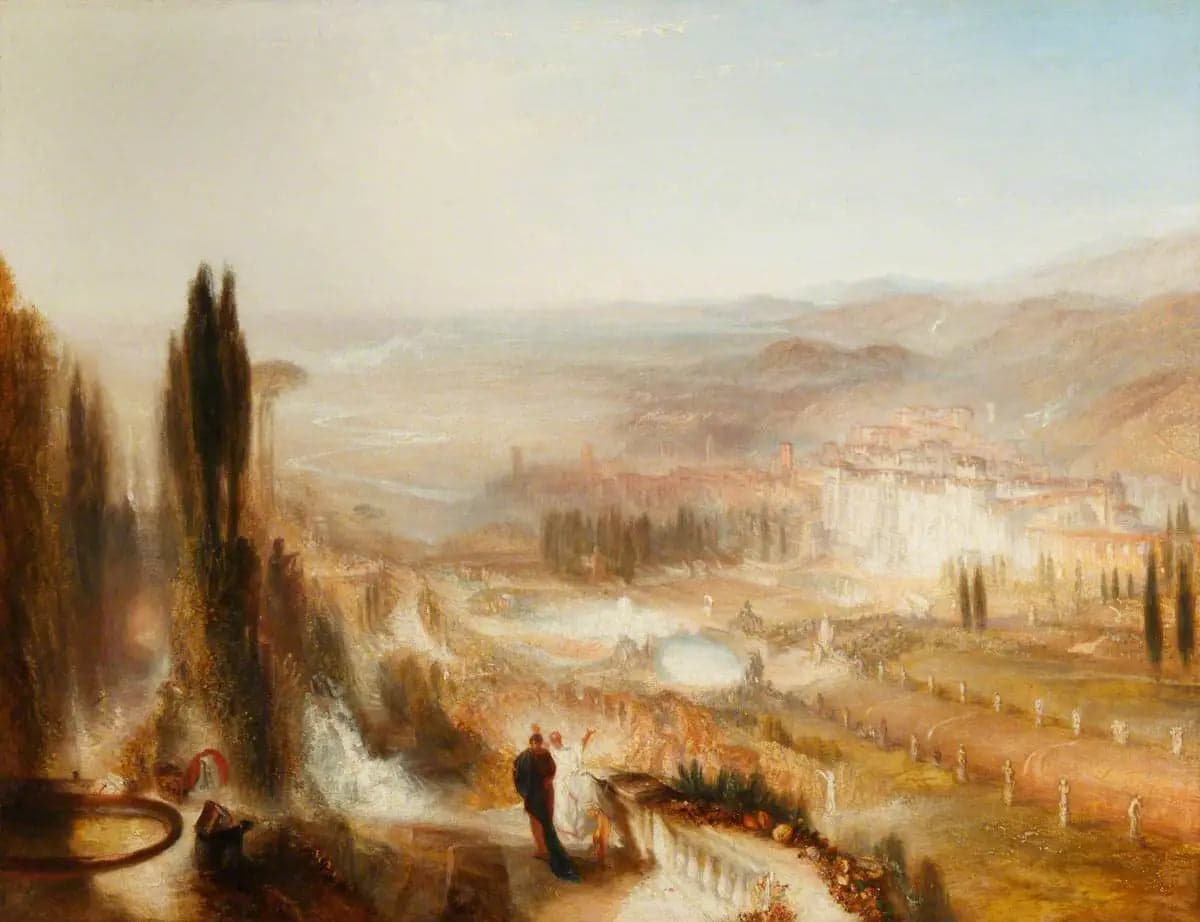
Cicero at His Villa at Tusculum
- Original dimensions
- 123.5 x 92.5 cm
- Museum
- Ascott House
Scene depicted
In this canvas , Turner transports us to the Villa of Tusculum, a reminiscence of Antiquity where Cicero was known for his wisdom. Through the golden light filtering through the branches, viewers can feel the tranquility of the great orator's thoughts. The scene reveals a moment of peace, a dialogue between man and nature, sublimated by the colorful harmony of the painting .
Historical context
Created around 1834, the famous painting "Cicero at His Villa at Tusculum" is set in the idyllic backdrop of the Roman countryside, embodying a precious moment of neoclassicism. The canvas is displayed at the Ascott House museum, where visitors can immerse themselves in the refined aesthetics of a Turner at the height of his talent. This pictorial work evokes not only the philosophy of the great Cicero but also the soothing atmosphere that prevailed in the Villa of Tusculum.
Place in the artist's career
"Cicero at His Villa at Tusculum" is part of Turner’s mature period, where he develops his own distinctive style. Alongside "The Fighting Temeraire" and "The Slave Ship," this canvas illustrates the evolution of his approach to light and emotion, demonstrating an emotional depth never before reached in his works.
Anecdote
"Light is the essence of colors," Turner would say as he sought to capture the softness of a spring morning emerging through the trees. Inspired by the surrounding nature and the serenity of the villa, he created this masterpiece where each brushstroke testifies to his love for the vibrant atmosphere he observes.