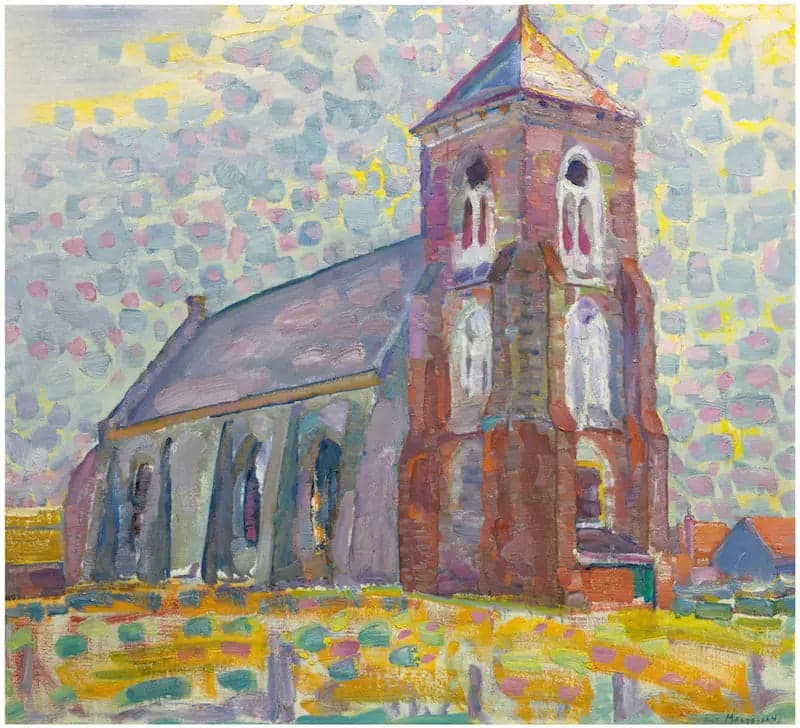
Church of Zoutelande
- Original dimensions
- 62 x 69 cm
- Museum
- Not specified
- Year
- 1909
Scene depicted
“Church of Zoutelande” presents a picturesque view of this landmark church, anchored in the marine and rural landscape of the Netherlands. The composition of the work invites us to explore the nuances of the architectural structure while immersing us in the tranquility of the surrounding setting. The geometric shapes, typical of Mondrian's style, blend harmoniously with the blue and golden tones, evoking a serene and calming atmosphere.
Historical context
Year: 1909 |BRK| Museum: Not specified |BRK| Dimensions: 62 x 69 cm
Place in the artist's career
This painting , a witness to a pivotal period in Mondrian's career, represents a transition to his more abstract style, which will culminate in his most famous works like “Composition in Red, Blue and Yellow.” At this time, he develops his artistic language, seeking to express the very essence of reality through the simplification of forms. Alongside “Church of Zoutelande,” paintings like “The Red House” mark a technical evolution, both in terms of composition and color use.
Anecdote
Piet Mondrian once stated: “Simplicity is the key to pure expression.” It is this quest for simplicity and harmony that inspired him to create this masterpiece . Imagine him in the early morning, contemplating the soft light reflecting on the walls of the church of Zoutelande, feeling a deep connection with the surrounding landscape. The painting capturing this ephemeral and memorable moment makes it a work of undeniable emotional power.