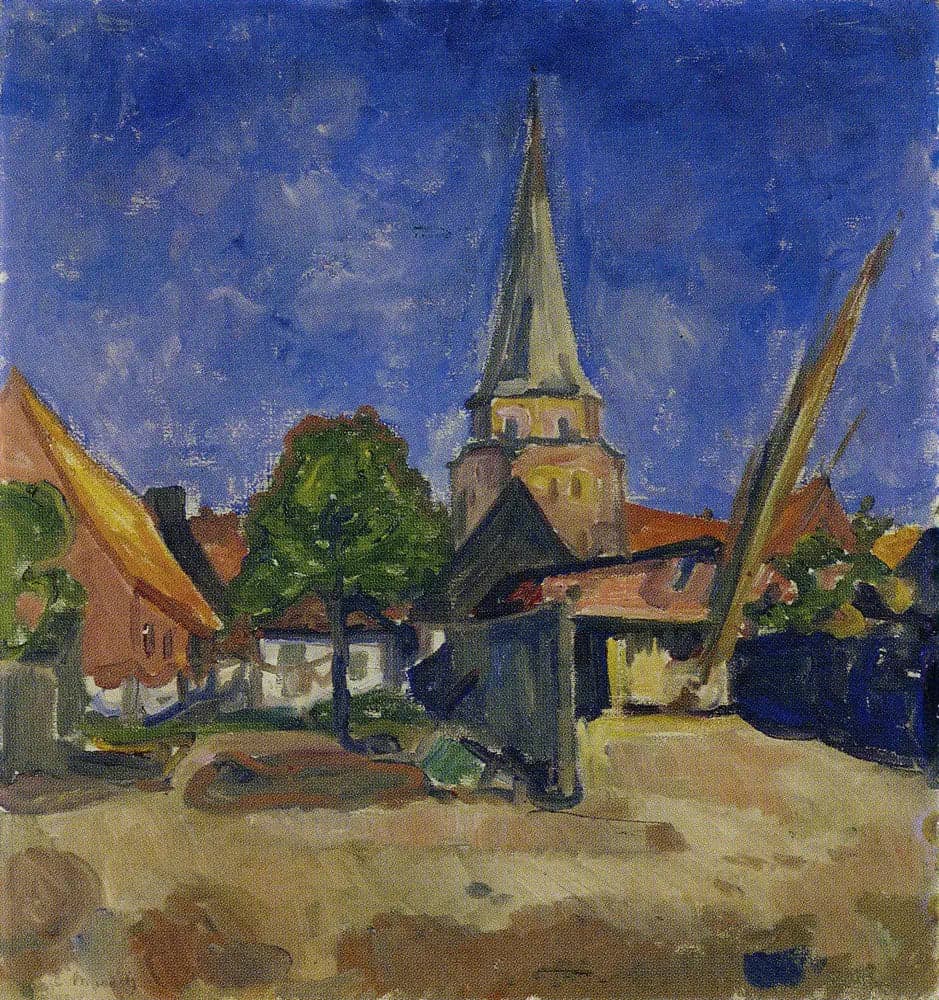
Church in Travemünde
- Original dimensions
- 65 x 70 cm
- Museum
- Not specified
- Year
- 1903
Scene depicted
This painting immerses us in the heart of a peaceful scene: a church stands majestically against a stormy sky, where colors and shapes intertwine to create an atmosphere that is both melancholic and mystical. The troubled clouds, vibrant with hues, seem to want to pour their tears onto the earth, while the church, a symbol of refuge and immortality, asserts itself serenely, commanding gaze and respect.
Historical context
Created in 1903, the painting "Church in Travemünde" is set against the cursed context of expressionism , a liberating artistic movement deeply rooted in Europe. An emblematic work of the Norwegian artist Edvard Munch , this canvas is painted in Travemünde, a charming coastal town in northern Germany. The painting is a poignant example of Munch's reflections on life, death, and ephemeral beauty. To this day, the location of the painting in a specific museum is not mentioned, but its dimensions evoke the grand emotions it conveys.
Place in the artist's career
"Church in Travemünde" is situated at a crucial turning point in Munch's career, marking his ascent in the world of Art with this painting imbued with maturity. This work, balanced between light and shadow, echoes "The Scream" and "The Madonna," two other paintings offering an intimate reflection on human emotions through a powerful and evocative visual language, testifying to a marked evolution in his technique.
Anecdote
"The painting is the expression of what I feel, a reflection of the outside world mixed with my interiors." This quote from Munch resonates strongly, as that morning, in this quiet town, the light breaking through the clouds electrified his creative spirit. The painting captures that fleeting moment where immediate beauty becomes eternal through the artist's expert touch, struck by the mystical charm of the canvas .