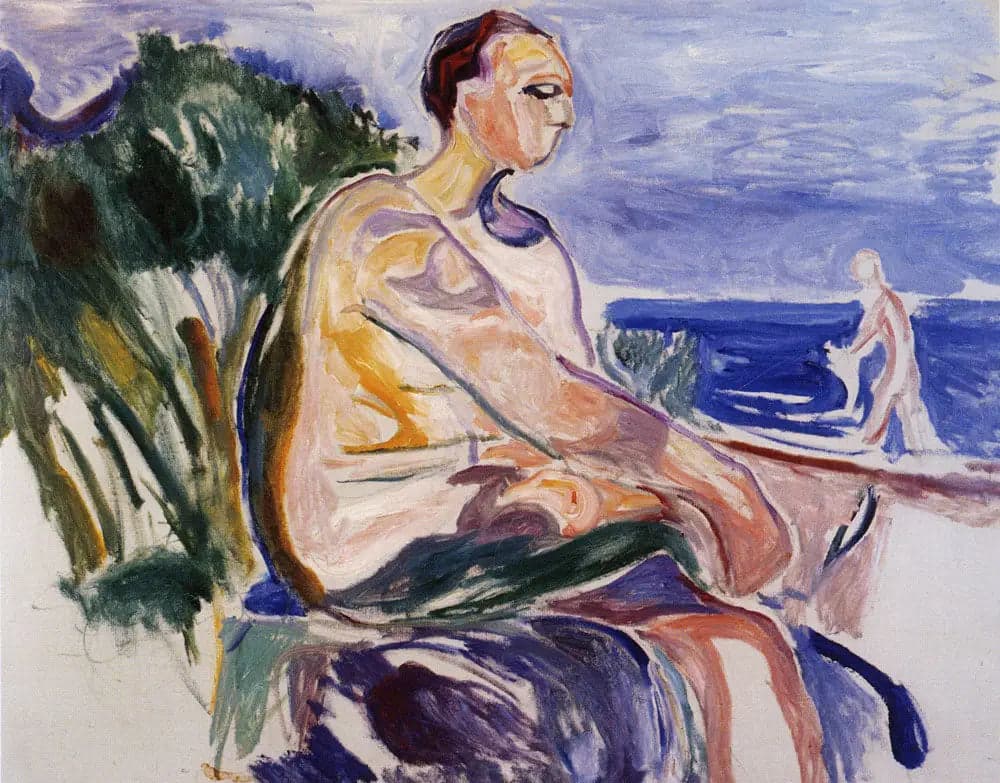
Christian Gierløff in Åsgårdstrand
- Original dimensions
- 136 x 107 cm
- Museum
- Not specified
- Year
- 1916
Scene depicted
Through this painting, Munch manages to transcribe the very essence of a human encounter. We discover Christian Gierløff, the central figure, whose contemplative expression evokes deep introspection, while the sublime background of the Norwegian sea blends with the changing skies.
Historical context
Created in 1916, this canvas emblematic of Edvard Munch emerges from Åsgårdstrand, a charming coastal town in Norway. This painting is part of the artistic movement of Symbolism, a time when art begins to explore the depths of the human soul. Currently, the painting remains untraceable in museum establishments, adding an aura of mystery to this artwork that measures 136 x 107 cm.
Place in the artist's career
This painting , the fruit of a period of maturity in Munch's career, coincides with other significant works such as "The Scream" and "The Dance of Life," revealing his evolution towards a more expressive and personal style. Christian Gierløff à Åsgårdstrand illustrates his transition to more intimate compositions, where the psychology of the subjects takes precedence.
Anecdote
Munch, captivated by the golden light of a spring morning, reportedly said: "Nature speaks in colors, and each painting is a story to discover." It was during his stay in Åsgårdstrand, in a quiet alley, that he captured the magical moment to give birth to this masterpiece , resonating with intense emotions.