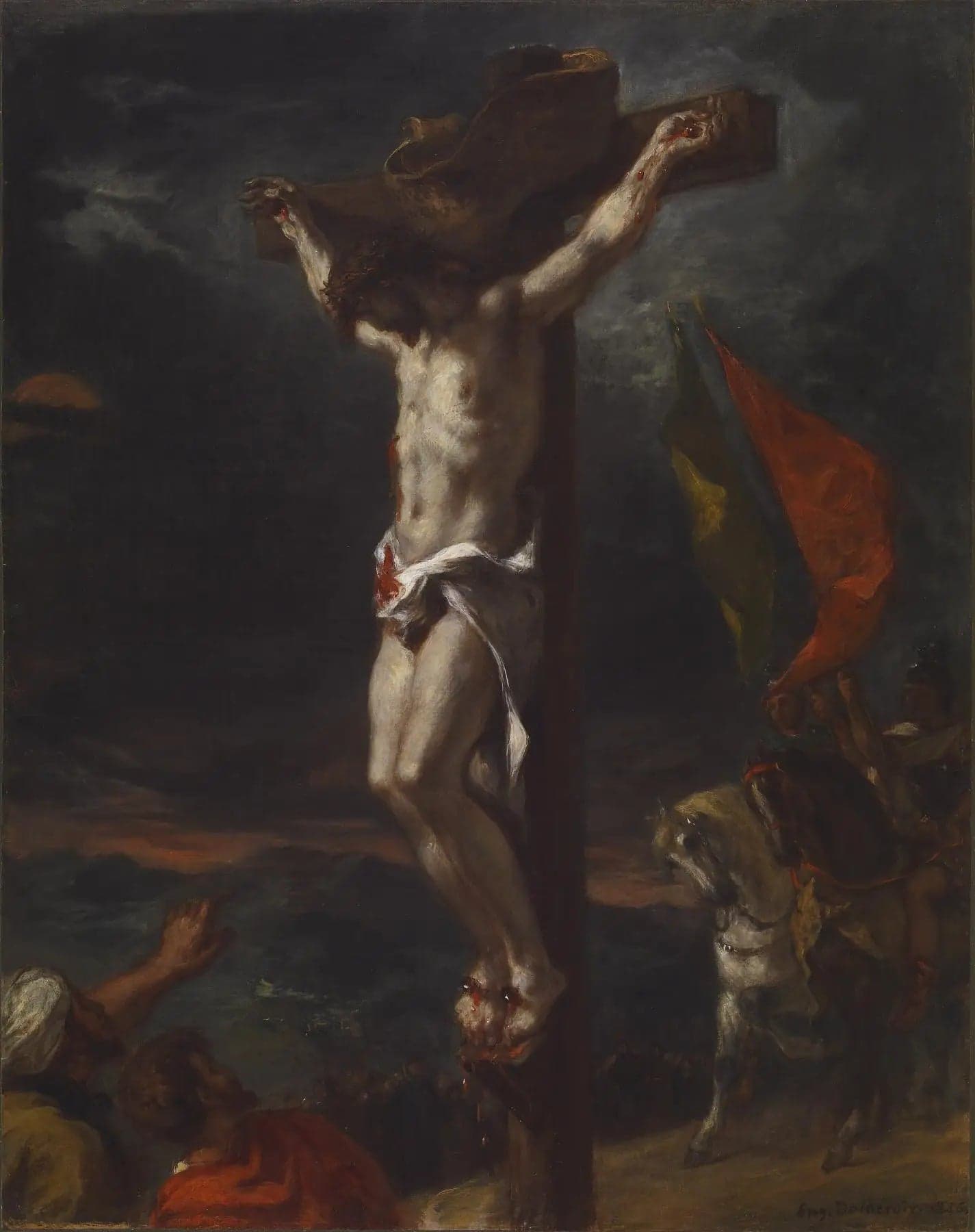
Christ on the Cross
- Original dimensions
- 17 x 24.5 cm
- Museum
- national museum Eugène-Delacroix
- Year
- 1848
Scene depicted
In this composition, Delacroix captures the poignant moment of the crucifixion. The body of Christ, stretched on the cross, evokes a desperate struggle, while his expression conveys both pain and serenity. The troubled sky seems to resonate with human tragedy, creating a dialogue between shadow and light, between sacrifice and redemption.
Historical context
In 1848, in a France undergoing transformation, The Christ on the Cross by Eugène Delacroix emerges as an emblematic work of romanticism. It was in the Saint-Germain-des-Prés district of Paris that the artist created this painting , combining his genius with a historical moment where passion and suffering intertwine. Currently exhibited at the national museum Eugène-Delacroix, this painting is a testament to the depth of human emotions, captured on a canvas of 17 x 24.5 cm.
Place in the artist's career
The Christ on the Cross is situated at a turning point in Eugène Delacroix's career, reflecting his stylistic evolution. This canvas is a pivotal step, halfway between his famous painting Liberty Leading the People and The Death of Sardanapalus , marking the transition to a darker and more introspective style.
Anecdote
Delacroix once declared: "Art is a silent cry that transcends time." Imagine him, one spring morning, observing a soft light dancing on the walls of his studio, inspired by the mystery of existence. It is this fleeting moment that nourished the evocative power of his painting , The Christ on the Cross, drawn from biblical narratives and the daring struggle of the human heart.