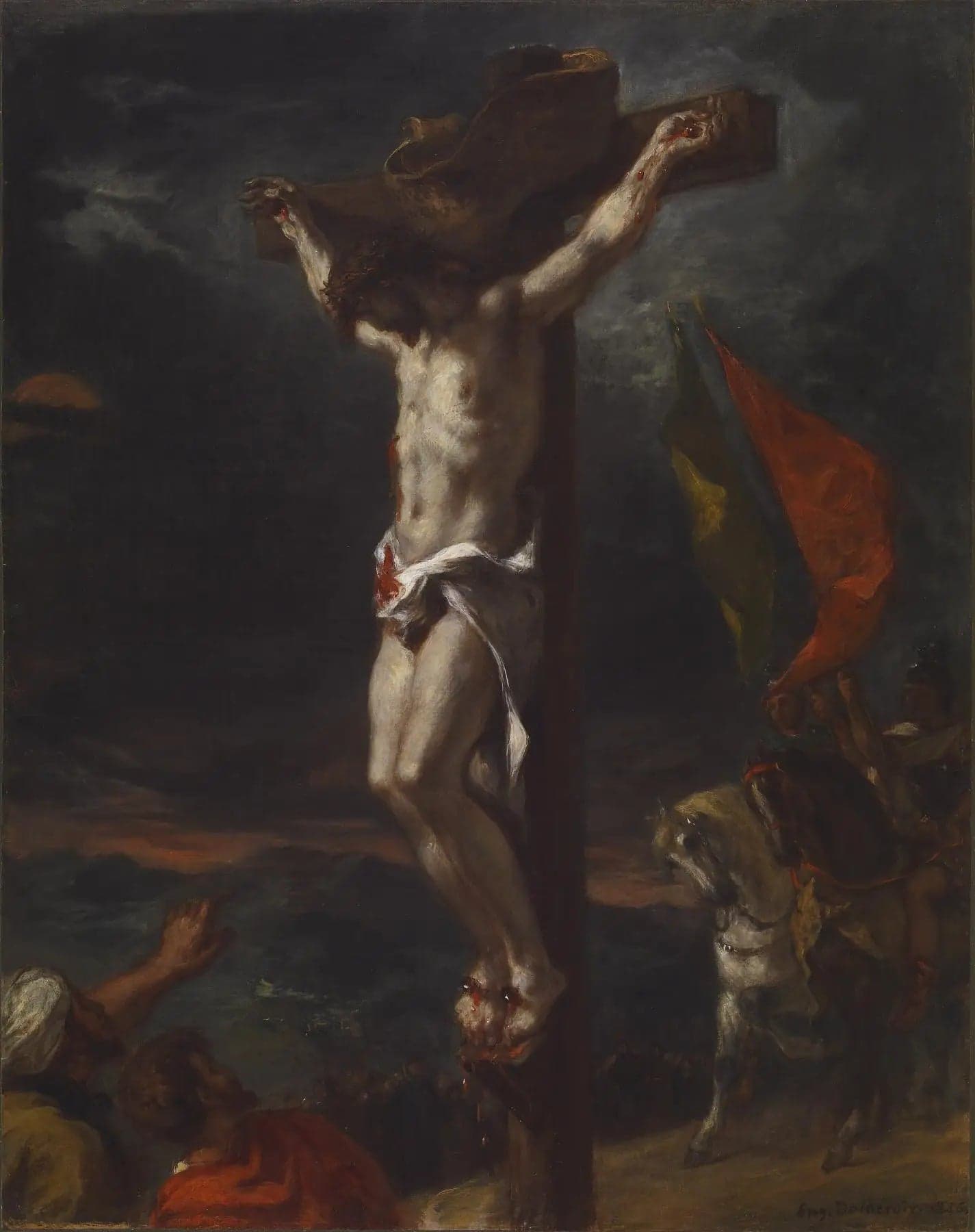
Christ on the Cross
- Original dimensions
- 64.2 x 80 cm
- Museum
- Walters Art Museum
- Year
- 1846
Scene depicted
The painting “The Christ on the Cross” immerses us in an epic scene, where suffering and redemption intertwine with palpable tension. Christ is suspended, surrounded by tormented skies, his suffering radiating through a bold composition that communicates a visual and emotional shock. The shadows, lights, and silhouettes evoke the weight of melancholy and hope.
Historical context
Created in 1846, this painting is emblematic of the artistic effervescence in Paris, a period where romanticism asserts itself with brilliance. Delacroix, a true pioneer of this movement, captures the tormented soul of his time. Today, this canvas is housed at the Walters Art Museum in Baltimore, where it continues to amaze visitors with its imposing dimensions of 64.2 x 80 cm.
Place in the artist's career
This canvas represents a turning point in Delacroix's career, a masterful fusion of his neo-classical influences and his emerging romantic style. Alongside “ Liberty Leading the People ” and “ The Massacre of Chios ”, “The Christ on the Cross” illustrates his ascent and constant evolution, both technically and emotionally.
Anecdote
“Art must be a cry, a breath.” Such are the words that Delacroix might have uttered one sunny morning, as he aspired to capture the mystery of suffering on canvas. Thus was born this pictorial work , the fruit of an emotional transcendence drawn from the depths of the human soul.
Major exhibitions
Delacroix (1798-1863)