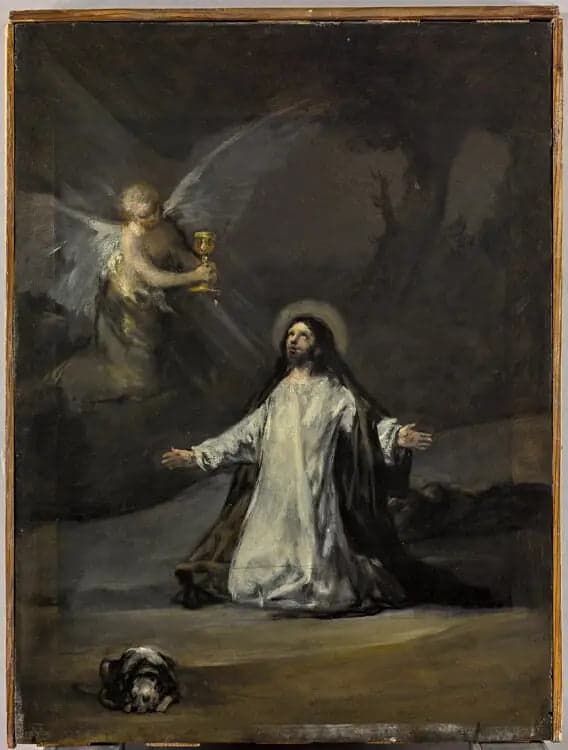
Christ in the Garden of Olives
- Original dimensions
- 35 x 47 cm
- Museum
- room 719, Museo del Prado, Madrid
- Year
- 1805
Scene depicted
This painting encapsulates a key moment of the Passion of Christ, where anguish and meditation blend in a soothing natural setting. The garden of olives thus becomes the symbol of Christ's inner struggle, illustrating the duality between humanity and the divine in a composition of remarkable intensity.
Historical context
Created in 1805 in the vibrant city of Madrid, this painting is a poignant testament to the romantic movement, sweeping away the artistic conventions of the time. It is currently displayed in room 719 of the prestigious Museo del Prado, welcoming art admirers under the watchful gaze of this canvas filled with emotion.
Place in the artist's career
The Christ in the Garden of Olives marks an important milestone in Goya's career, illustrating a period of artistic maturity. In contrast to his earlier works, such as The Naked Maja and The Disasters of War, this painting reveals a more complex emotional-psychological depth, a testament to undeniable technical evolution.
Anecdote
“Inspiration is born in moments of solitude, where the soul hears the whispers of the divine,” Goya might have declared as he spent his days exploring the gardens of the city. That spring morning, bathed in soft light, a crucial scene germinated in his mind, bringing this masterpiece to life.