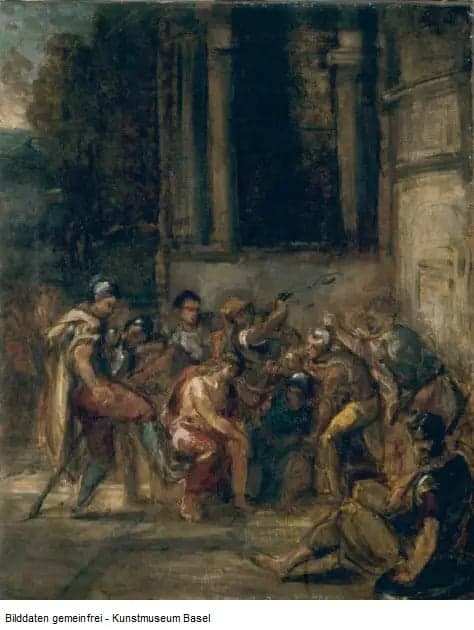
Christ at the Praetorium
- Original dimensions
- 74 x 93 cm
- Museum
- Kunstmuseum Basel
- Year
- 1849
Scene depicted
In this rich and dramatic composition, Delacroix immerses us in the trial of Jesus Christ, where tension, moral dilemma, and human suffering intertwine. The figures are dramatically arranged, their expressions and gestures revealing the intensity of the scene: the judges, surrounded by guards, confront the innocence of Christ amidst a vibrant clamor of pain and revolt. Every element of this painting tells a story, every brushstroke evokes a raw emotion.
Historical context
Created in 1849, this canvas is set against the tumultuous backdrop of Romanticism in France. In a time of political and social upheaval, Eugène Delacroix managed to resonate with the human soul through his paintings . Today, this painting resides at the Kunstmuseum in Basel, Switzerland, a sanctuary of the arts where it continues to inspire and move its visitors.
Place in the artist's career
The Christ at the Praetorium represents a major turning point in Delacroix's career, merging his mastery of emotions with the strength of Romanticism. Compared to other iconic paintings such as Liberty Leading the People and The Last Moments of the Church of Saint-Germain, this painting validates his evolution towards increasingly bold compositions, both in subject and expression.
Anecdote
“Human passion is the greatest of muses.” In this thought from Delacroix, we find the very essence of his masterpiece . That morning, observing faces crossed in a sunlit alley, the artist felt an irresistible surge. It was this fleeting moment that infused emotional power into this painting , a moment forever captured in the canvas .