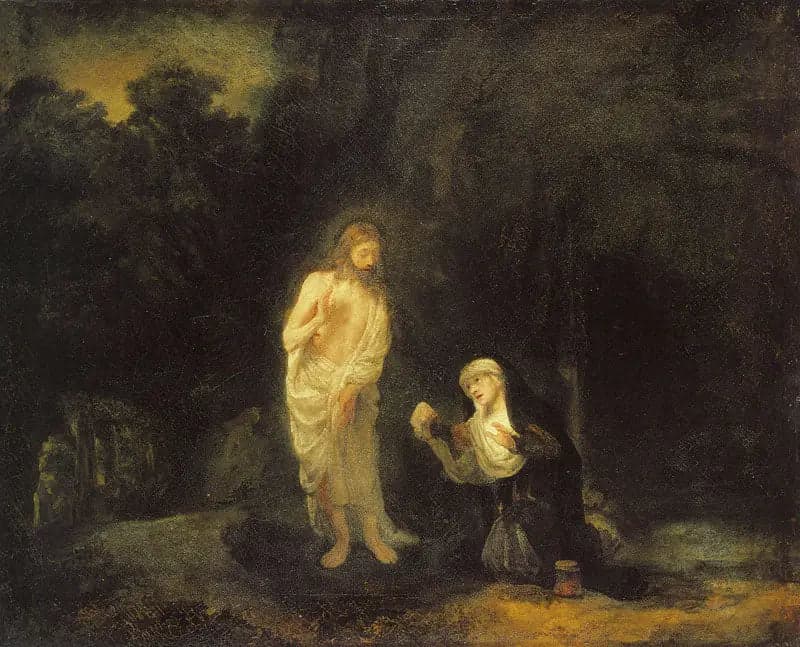
Christ Appearing to Mary Magdalene, "Noli me tangere"
- Original dimensions
- 79 x 65 cm
- Museum
- Herzog Anton Ulrich Museum
- Year
- 1651
Scene depicted
In this pictorial work , Rembrandt captures the poignant moment when the risen Christ reveals himself to Mary Magdalene. This iconic scene, drawn from the Gospels, highlights the intimate and spiritual relationship between the two characters. Surprise and devotion are evident on Mary Magdalene's face, while the divine light emanating from Christ resonates with the promise of resurrection and hope. The composition thus emphasizes the duality of the sacred and the profane, making this canvas a true testament of faith.
Historical context
Created in 1651, this painting is set against the innovative backdrop of the Dutch Golden Age, marked by an unprecedented artistic effervescence. In Brunswick, where the museum currently housing this canvas is located, Rembrandt offers an emotive and spiritual vision, typical of the baroque movement that shaped his time. The painting stands out as a major work, not only for the artist's technical mastery but also for the emotional depth it conveys.
Place in the artist's career
The Christ Appearing to Mary Magdalene is positioned at the heart of Rembrandt's career, marking a period of artistic maturity. This painting echoes other iconic works, such as The Night Watch and The Boat of Dante, reflecting a technical and emotional evolution. These masterpieces illustrate the artist's constant quest to capture the human soul through his portraits and religious scenes.
Anecdote
“Light is more than just a material, it is the soul of the painting ,” Rembrandt is said to have declared while observing the sunrise one April morning. This intimate moment of inspiration fueled the genesis of this painting , where each ray of light bears witness to a sacred encounter between Christ and Mary Magdalene, evoking an unforgettable sweetness of the moment.