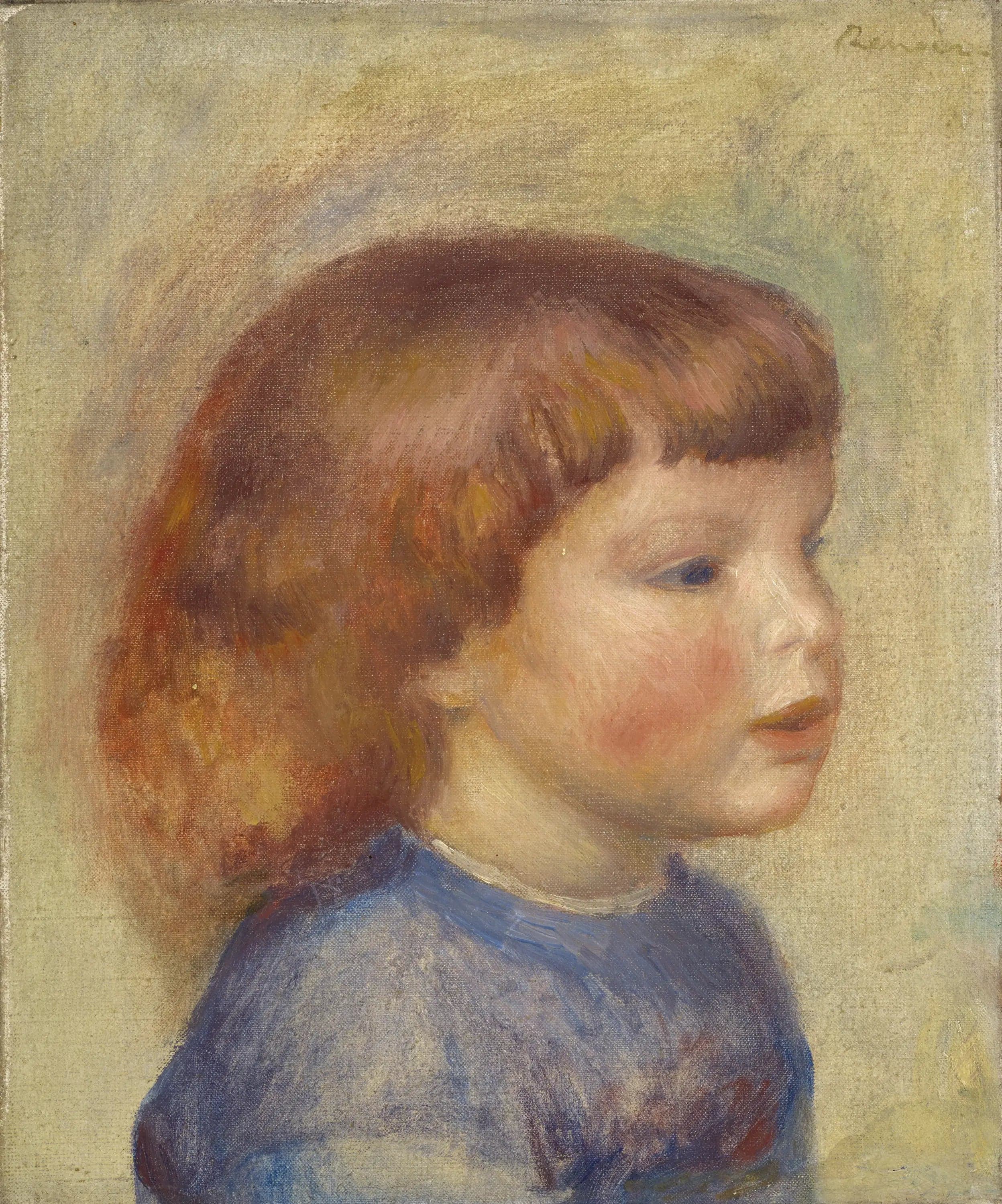
Child's Head - Pierre
- Original dimensions
- 25 x 30 cm
- Museum
- Kunstmuseum Basel
- Year
- 1906
Scene depicted
The painting "Tête d'enfant" illustrates the innocence and purity of childhood. Renoir succeeds in capturing not only a form but also an essence, that of wonder at the simple beauty of life. The child's facial features, marked by softness and fragility, subtly stand out against a blurred background, accentuating the brilliance of emotion.
Historical context
Created in 1906, the painting "Tête d'enfant" is fully part of the Impressionist period, an artistic movement born in France, which combines light with a partial and instinctive vision of reality. This pictorial work is currently exhibited at the Kunstmuseum in Basel, Switzerland, where it attracts art lovers and historians. Its modest dimensions, 25 x 30 cm, give an intimacy to this canvas , a window into the innocence of childhood captured by Renoir's brush.
Place in the artist's career
The painting "Tête d'enfant" represents a turning point in the career of Auguste Renoir , testifying to his growing mastery of light and color. During this period, he oscillates between the freshness of his beginnings with "Luncheon of the Boating Party" and the emotional depth of his later works like "The Bathers." Each painting, a step in his evolution, reveals the vibrant soul of this exceptional artist.
Anecdote
"Childhood is an ephemeral period, a breath, a soft light," Renoir might have said, inspired by the face of a young child he encountered one morning in the gardens of Montmartre. It is this scene of life that gave birth to the masterpiece , resonating with the musicality of children's laughter and the scent of blooming flowers. The painting is imbued with this sweet nostalgia.