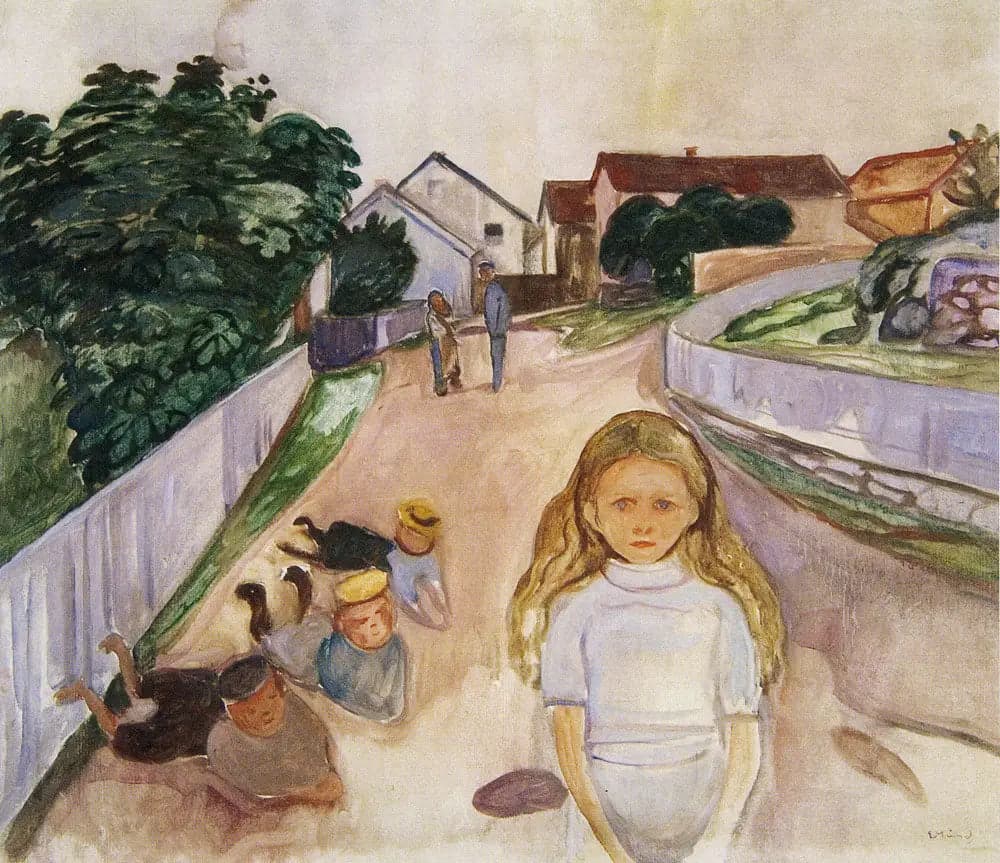
Children Playing in the Street at Åsgårdstrand
- Original dimensions
- 89.2 x 75 cm
- Museum
- Bergen Art Museum
- Year
- 1901
Scene depicted
In this painting , Munch depicts children joyfully moving in a street where light plays with the bright colors of their clothing. The composition captures a moment of pure escape, where the sound of their laughter seems to rise above the hues of the surrounding nature, triggering both nostalgia and wonder.
Historical context
Painted in 1901, this iconic work was created in the charming coastal town of Åsgårdstrand in Norway, a place that inspires so much creativity. Munch, a prominent figure of symbolism , juxtaposes here the childlike innocence with an environment charged with emotions. This painting is now preserved at the Bergen Art Museum, testifying to a time when artistic movements were reinventing themselves.
Place in the artist's career
This painting is a milestone in Munch's career, revealing his skill in exploring deep themes through everyday scenes. It stands out for its apparent simplicity, in contrast to paintings like “The Dance of Life” and “The Scream,” which address darker emotions. In each of these masterpieces , one perceives a progression towards increased expressiveness.
Anecdote
Munch often stated: “Inspiration is found in the spontaneity of children, in their innocent games and eternal joy.” One morning, wandering the streets of Åsgårdstrand, he observed a group of children entertaining themselves under the sun, driven by carefreeness. This scene would have suddenly illuminated his creative mind, pushing him to capture this quintessence of childhood through painting .