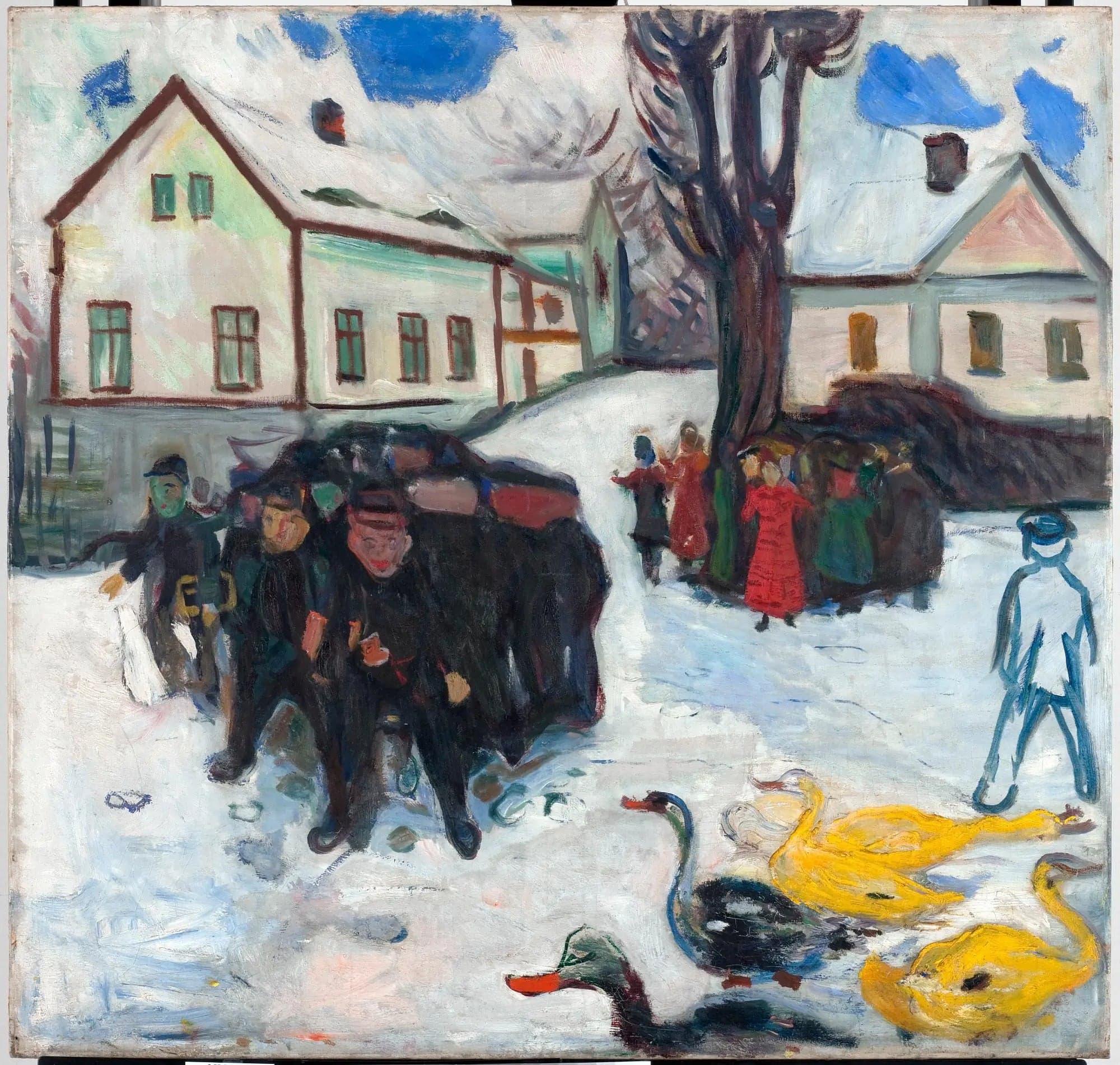
Children and Ducks
- Original dimensions
- 105.5 x 100.5 cm
- Museum
- Munch Museum
- Year
- 1906
Scene depicted
This painting beautifully depicts a fascinating moment where the innocence of children intertwines with nature. By the edge of a pond, amazed children joyfully interact with ducks, plunging the viewer into an atmosphere of pure joy and tranquility. The work then becomes a true visual poem, celebrating the harmony between man and his environment.
Historical context
Created in 1906, the painting Children and Ducks is part of the rich heritage of the city of Oslo, Norway, where Edvard Munch elaborates visual memories of his emotions through art. This canvas belongs to the expressionist movement, a trend that seeks to translate deep feelings and inner realities. Currently housed in the Munch Museum, this painting of majestic dimensions already immerses us in the poetic atmosphere of its time.
Place in the artist's career
The painting Children and Ducks is an emblematic illustration of Munch's artistic maturity. Revealing a shift towards a more sensitive definition of expression, it echoes his works such as The Scream and The Madonna , where emotional dynamics reach their peak. This masterpiece of children and ducks constitutes a pivotal moment in the narrative evolution of his pictorial style.
Anecdote
“I have always been fascinated by the simplicity of fleeting moments.” Inspired by a spring morning when he encountered children playing near a lake, Munch transcribes this carefree and bright atmosphere into his masterpiece . It reminds us that childhood, filled with joy and curiosity, is an integral part of our collective memory.