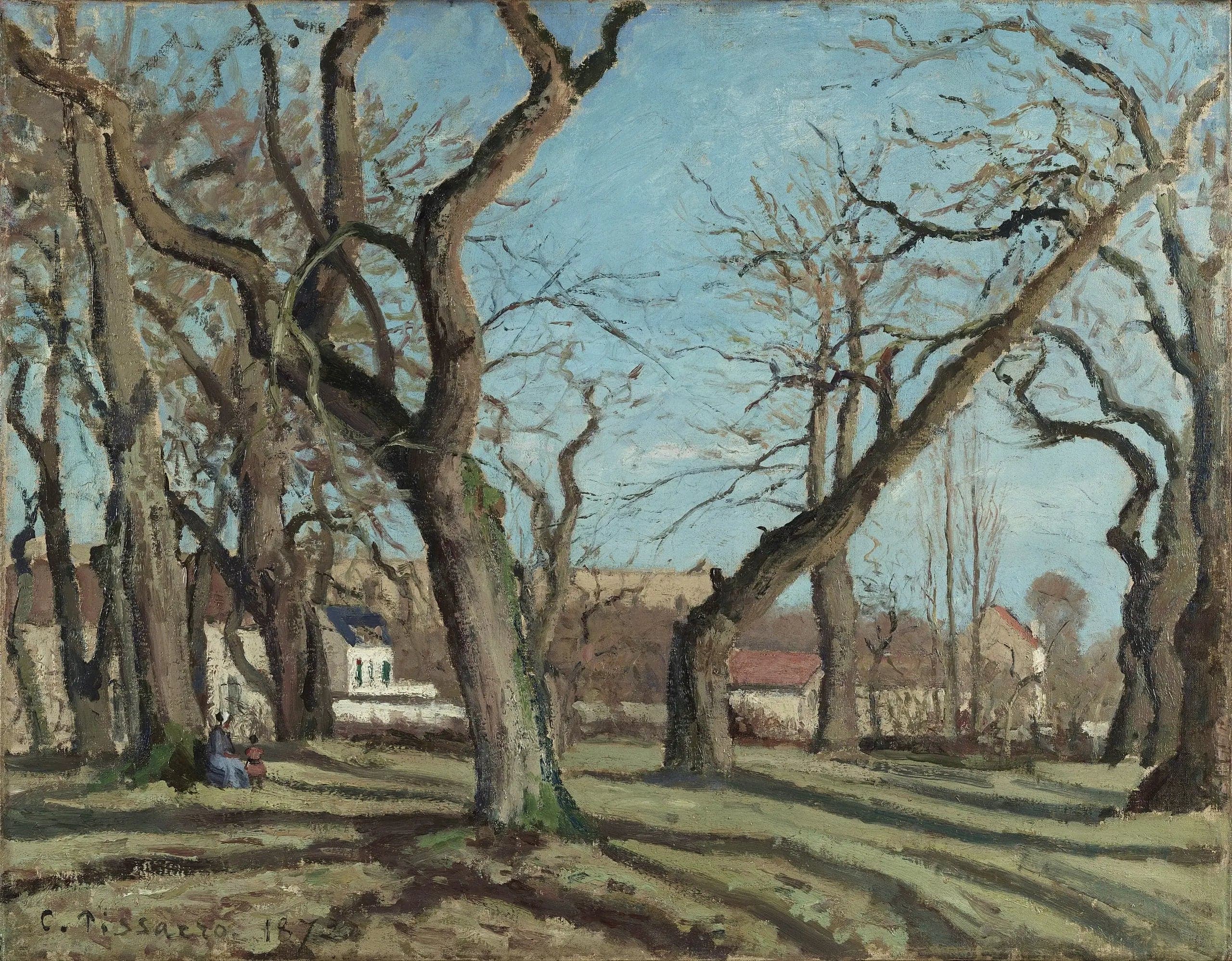
Chestnut Wood in Louveciennes
- Original dimensions
- 53.34 x 41.59 cm
- Museum
- Nelson-Atkins Museum of Art
- Year
- 1872
Scene depicted
In the painting “Chestnut Woods in Louveciennes,” Camille Pissarro depicts a sunlit rural landscape, where the majestic chestnut trees stand proudly, silently observing the life that flows peacefully. This artwork captures the gentle ballet of shadows and lights paying homage to natural beauty, like an ode to the tranquility of the French countryside in the 19th century.
Historical context
Created in 1872, this painting is a reflection of a precious artistic moment in the commune of Louveciennes, located in the Yvelines region of France. During this period, Camille Pissarro , a major figure of Impressionism , was focused on capturing the ephemeral beauty of nature through his works. Currently, this canvas is preserved at the Nelson-Atkins Museum of Art , where it continues to inspire generations of admirers.
Place in the artist's career
The painting “Chestnut Woods in Louveciennes” marks a turning point in Pissarro's career, beautifully illustrating his artistic maturation. It can be paralleled with other notable canvases such as “The Road to Chantilly, circa 1870” and “The Artist's Garden at Éragny,” showing both technical and emotional evolution towards bolder and more Impressionist compositions.
Anecdote
“It was there, under the chestnut trees, that a gentle whisper of the wind guided me to capture the light of that day.” It was a spring morning, where nature seemed to sing, that inspired Pissarro to immortalize this scene. The painting awakens in us a deep connection to this fleeting moment, an audible memory of the softness of the leaves and the earthy scent of the forest.