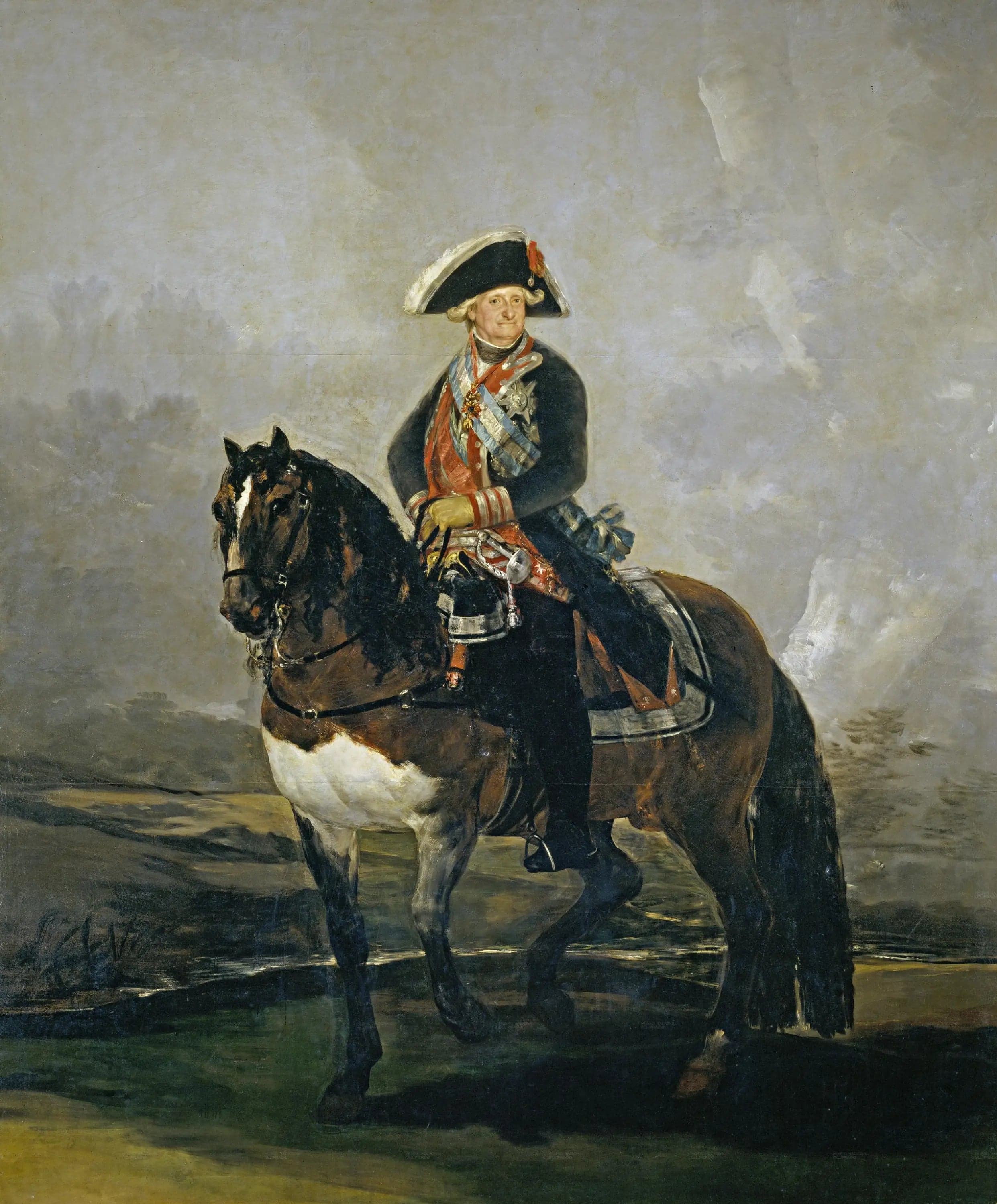
Charles IV on Horseback
- Original dimensions
- 282 x 336 cm
- Museum
- Prado Museum
- Year
- 1800
Scene depicted
The painting features Charles IV, dressed in his royal garments, on horseback, symbolizing the power and grandeur of a kingdom in full transformation. Beside him stand his family and advisors, each exquisitely dressed, illustrating both the wealth of power and the intrigues of the court at the end of the 18th century. The exchanged glances, the postures, the palpable tension between each character make this work a living chronology of Spanish history.
Historical context
Created in 1800, this painting is the result of the imagination of one of the greatest masters of the Spanish romantic movement, Francisco de Goya . At that time, Madrid was the cradle of a cultural effervescence marked by political and social upheavals, reflecting the tensions experienced by the Spanish people. The painting "Charles IV on horseback" is now carefully preserved in the Prado Museum, a must-visit place for anyone wishing to admire this masterful pictorial work, measuring 282 x 336 cm.
Place in the artist's career
"Charles IV on horseback" stands as a pivot in Goya's career, an emerging artist who then asserts himself as the court painter. By comparing it to other works such as "The Naked Maja" and "The Third of May 1808," one can discern the rapid evolution of his technique. The mastery of shadows, lights, and human emotions merge to transition from an intimate representation to an ambitious historical fresco.
Anecdote
"Every brushstroke is a breath of life," Goya might have confided in the intimacy of his studio during the conception of this masterpiece . Inspired one sunny morning by the majesty of the royal court, he chose to capture the nobility of King Charles IV. The movement of a horse, the presence of the sovereign, and the ambient brightness infuse a dynamic quality to this canvas that enchants those who observe it.