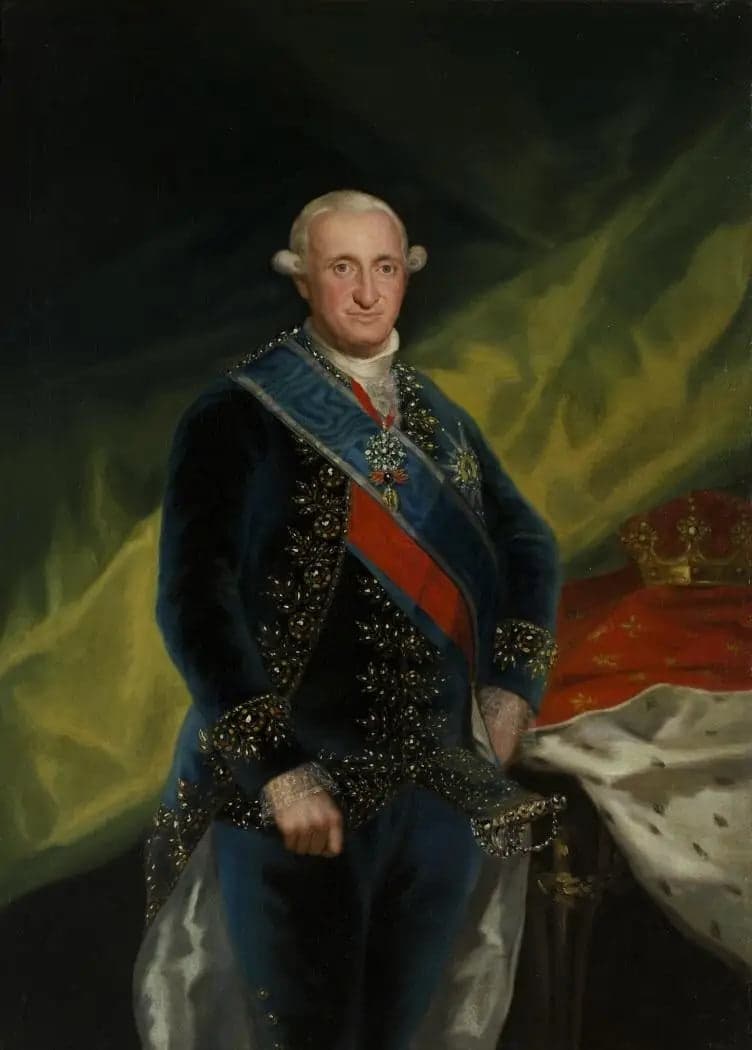
Charles IV of Spain
- Original dimensions
- 110 x 152 cm
- Museum
- Museum of Zaragoza
- Year
- 1789
Scene depicted
This painting , which depicts King Charles IV surrounded by his family, offers a poignant vision of the Spanish monarchy of the 18th century. Goya, as a master of observation, captures not only the physical traits of his subjects but also their psyche, their hidden emotions. The expressions are striking, interpreting the complexity of family relationships and royal responsibilities. This canvas thus becomes a true visual chronicle of its time.
Historical context
Created at the end of the 18th century, in the charming city of Zaragoza, this painting by Francisco de Goya represents a crucial moment in Spanish history. Rooted in the artistic movement of romanticism , a time of transition and upheaval, this canvas finds its place among the masterpieces of the painter, who asserts himself here with boldness and depth. Currently housed in the Museum of Zaragoza, this work stands out with its impressive dimensions of 110 x 152 cm, a visual epic that speaks of royalty and power.
Place in the artist's career
The painting "Charles IV of Spain" represents a crucial point in Goya's career, marking his period of artistic maturity. Alongside other works like "The Maids of Honor" and "The Family of Charles IV", this canvas highlights the artist's growing mastery of psychological depth and social critique. It is here that Goya distances himself from a mere historical representation to enter a more personal and introspective reflection.
Anecdote
Francisco de Goya once stated: "Painting must capture the soul of the subjects, their inner truth." Perhaps it was after a spring morning, when the light gently filtered through the curtains of his studio, that the idea for this masterpiece came to him. His encounter with Charles IV, his deep gaze and regal bearing, was an inexhaustible source of inspiration for creating this immersive and poetic canvas .