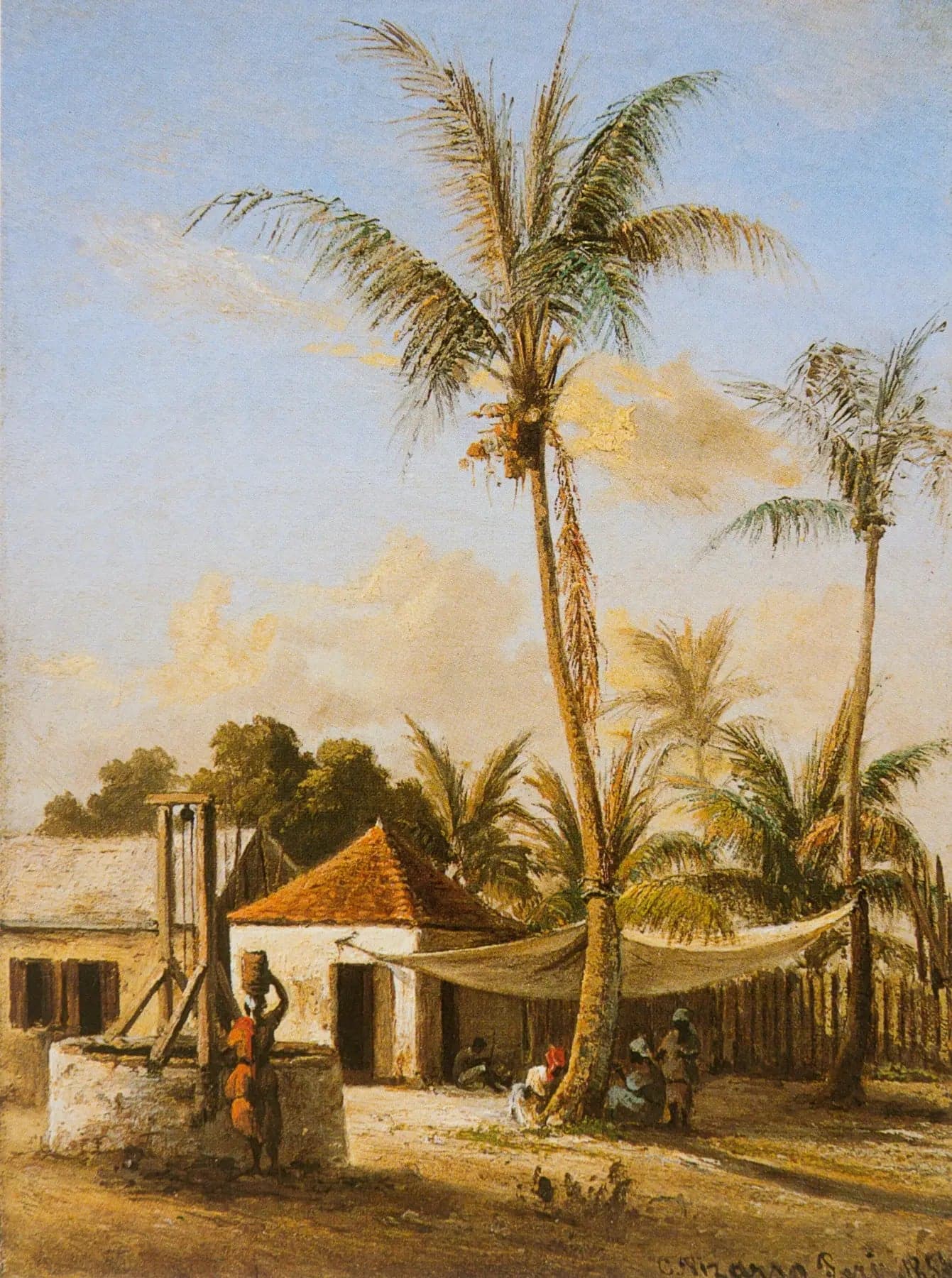
Character resting in a village near a well
- Original dimensions
- 24 x 32 cm
- Museum
- Not specified
- Year
- 1856
Scene depicted
In this pictorial work, a character rests in the shade, near an ancient well, evoking the soothing rhythm of village life. Pissarro, with finesse, captures not only the moment but also the overall atmosphere of a moment suspended in time. The presence of this well, a symbol of abundance and access to water, speaks to us of a fundamental connection between man and nature, a reflection on voluntary simplicity that the artist highlights.
Historical context
Created in 1856, this painting is emblematic of the Impressionist movement, which flourished at that time in France. Camille Pissarro , a master of the movement, created this canvas in the heart of a small village, probably in Normandy or Île-de-France, a region where he often drew his inspiration. Although the museum where this painting is currently displayed is not specified, its impact is felt in galleries around the world, waiting to be admired again.
Place in the artist's career
This painting represents a turning point in Camille Pissarro 's career, revealing both his undeniable talent and his humanistic approach. Promising in the early days with works like “The Harvest” and mature with iconic pieces such as “Boulevard Montmartre, spring,” this painting illustrates his stylistic evolution towards a more personal and sensory expression. This moment of calm before the Impressionist storm is both a culmination and a logical continuation in his work.
Anecdote
“Light is my greatest ally, it dances and sings on every canvas, revealing the hidden soul of nature.” Camille Pissarro might have whispered this on a quiet morning while painting this composition . Imagine a spring morning, where the soft rays of the sun brushed the surface of his painting , allowing him to capture the very essence of rest and rural simplicity.