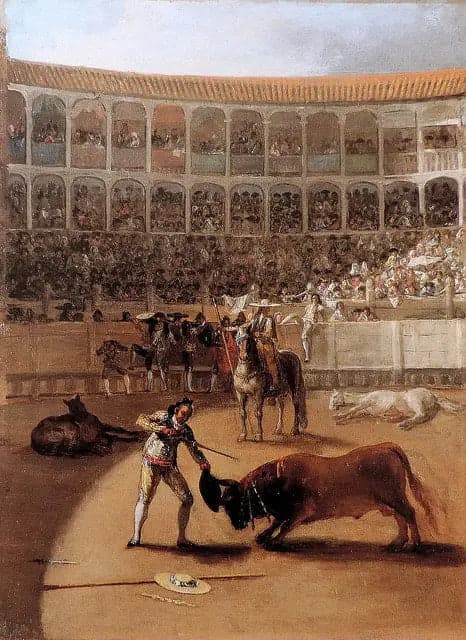
Chance to Kill
- Original dimensions
- 31 x 42 cm
- Museum
- Not specified
- Year
- 1793
Scene depicted
The scene of the painting “Chance de tuer - Francisco de Goya ” immerses the viewer in a dark and dramatic atmosphere. It evokes a moment of tension, where a life hangs in the balance between opportunity and imminent death, illustrating the fragility of human existence. This composition aims to capture the essence of human tragedy, a reflection on the consequences of choices and violence in Goya's time.
Historical context
Created in 1793, this painting results from the genius of Francisco de Goya , an iconic artist of Spanish romanticism . At that time, Spain was plagued by political turmoil, and its art was profoundly marked by it. The canvas , measuring 31 x 42 cm, is not part of a specific museum collection, but it is an undeniable testimony to the tension and anguish of its time.
Place in the artist's career
“Chance de tuer” is part of an emblematic period in Goya's career, during which he created darker works, before plunging into the hallucinations of his illness. Alongside “La Maja Desnuda” and “Les Désastres de la Guerre,” this painting illustrates his evolution towards a more raw and realistic representation of human emotions, marking a significant turning point in his artistic style.
Anecdote
“Art is the mirror of the soul, and this one reflects the sufferings of a world at war.” These words might resonate in Goya's mind as he sketches the canvas in a dark and silent alley, capturing the horror of a time when every glance and every gesture seem laden with threats. The painting thus becomes a poignant expression of his inner reality.