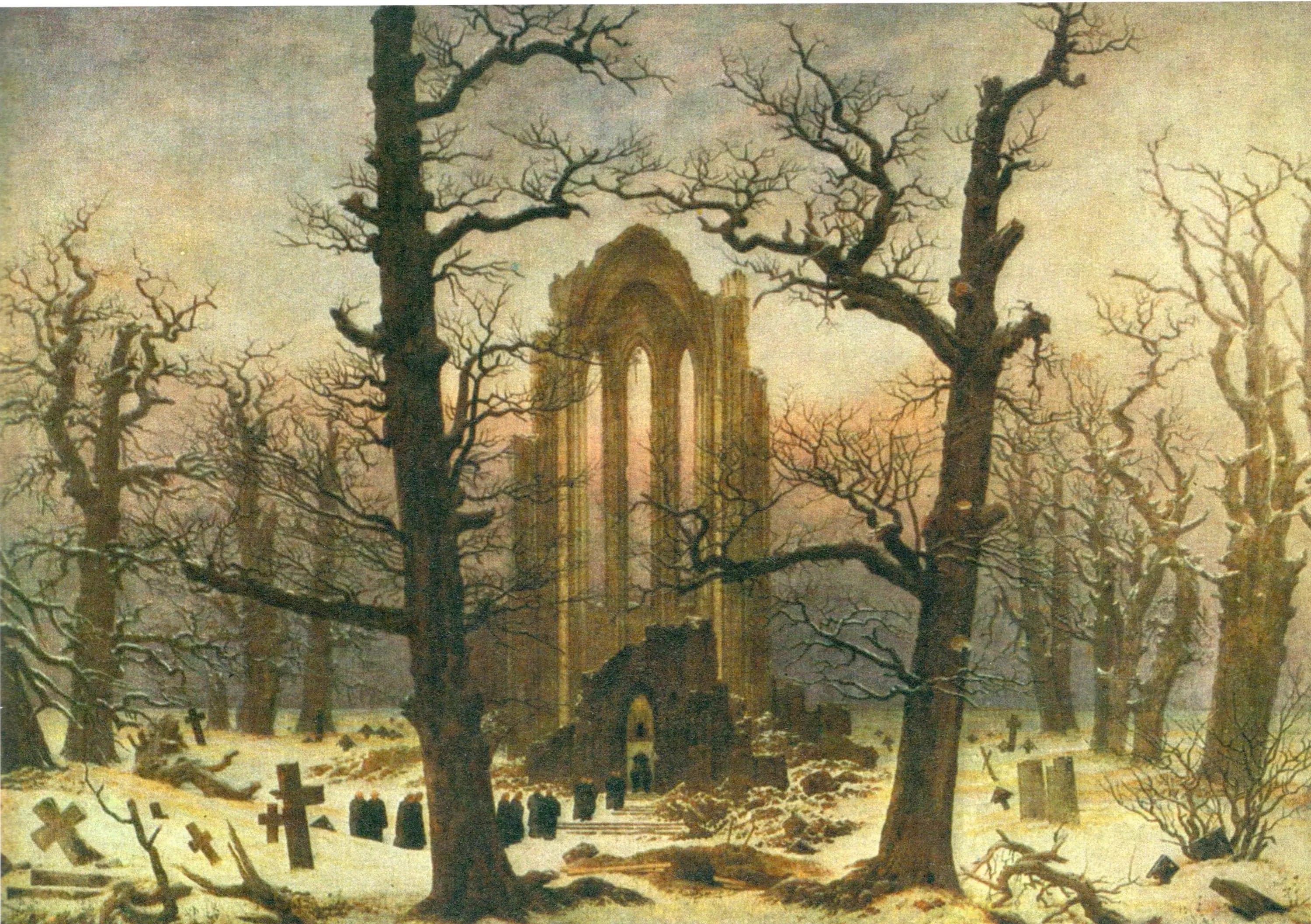
Cemetery of a Cloister Under the Snow
- Original dimensions
- 170 x 121 cm
- Movement
- romanticism
- Museum
- Flakturm Friedrichshain
- Year
- 1819
Scene depicted
The painting depicts a winter scene, a peaceful cemetery extending under a blanket of immaculate snow. The graves, covered in white, evoke both death and serenity. The soft, diffused light envelops the entire composition, creating a striking contrast with the clarity of the crosses, which, although melancholic, stand majestically, as if watching over the eternal rest of those buried there.
Historical context
Created in 1819, this painting is located in the city of Berlin, Germany, a nerve center of the romantic movement. Friedrich, an emblematic figure of this current, uses this painting to evoke spiritual and inner unions with nature. The canvas is housed in the Flakturm Friedrichshain, where it continues to captivate visitors with its atmospheric depth.
Place in the artist's career
This painting is a significant milestone in Friedrich's career, illustrating his romantic style at its peak. It reflects an evolution towards a more introspective approach, parallel to other works such as The Wanderer above the Sea of Fog and The Monk by the Sea . Each of these canvases reveals the artist's quest to capture the beauty of landscapes while reflecting human emotion.
Anecdote
Friedrich once declared: “The beauty of nature is but a reflection of the human soul.” This reflection arose while he was on a frozen morning, contemplating the serenity of a convent asleep under the snow. The painting that results, Cemetery of a Cloister in the Snow, captures this atmosphere of almost mystical tranquility.