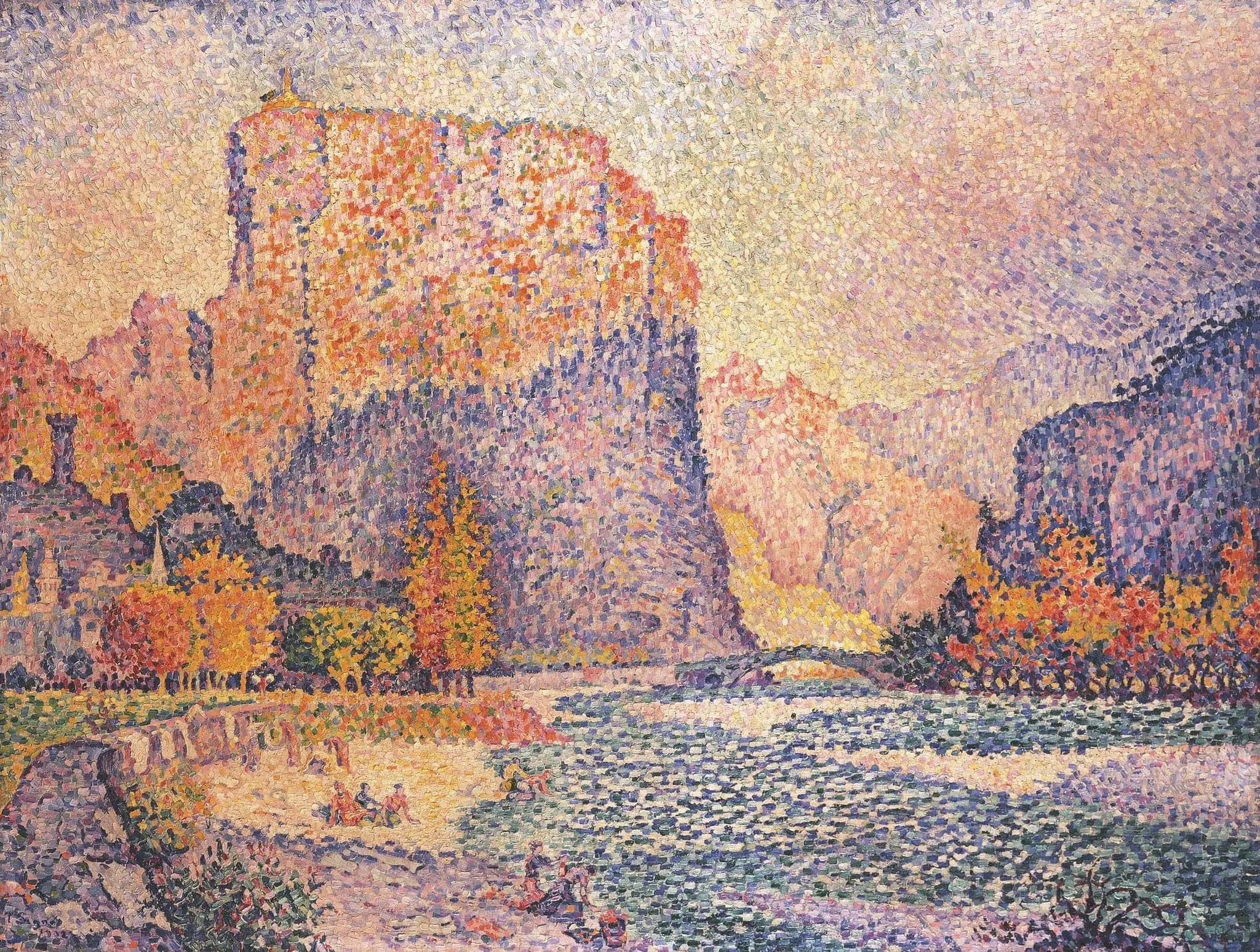
Castellane
- Original dimensions
- 114.5 x 88 cm
- Movement
- pointillism
- Museum
- Not specified
- Year
- 1902
Scene depicted
"Castellane - Paul Signac " is a painting that vibrates with colors and brightness, representing the picturesque village of Castellane in the south of France. The composition invites the viewer to explore the rich hues of the landscapes, where the lush hills meet the bright blue of the sky. The technique of pointillism , through the play of small dots of color, creates a visual harmony, propelling the viewer into this moment suspended in time.
Historical context
Created in 1902, the painting "Castellane" is at the heart of the pointillist movement, one of the avant-garde currents of the late 19th century. Paul Signac , at that time, immerses himself in the vibrant lights and colors of his region. As art transforms, this canvas becomes a precious testimony of this flourishing era. Currently, the location of the painting remains uncertain, shared among various private collections, and its impressive dimensions of 114.5 x 88 cm add to its visual power.
Place in the artist's career
This painting stands at a crossroads between the promising beginnings of Paul Signac and his artistic mastery. Alongside " The Port of Marseille " and " Portrait of Félix Fénéon ", "Castellane" reveals an evolution towards a brighter light and a confident brush technique, marking a significant step in his artistic journey.
Anecdote
"Light is a melody, a score in color," said Paul Signac , reminiscing about a summer morning when inspiration struck him. Looking at the sparkling waters of Castellane, he let himself be carried away by the dance of reflections, capturing the very essence of this place in his masterpiece . The painting then becomes an open window to the pure beauty of nature.
Major exhibitions
Private collections: A journey from Impressionists to Fauves