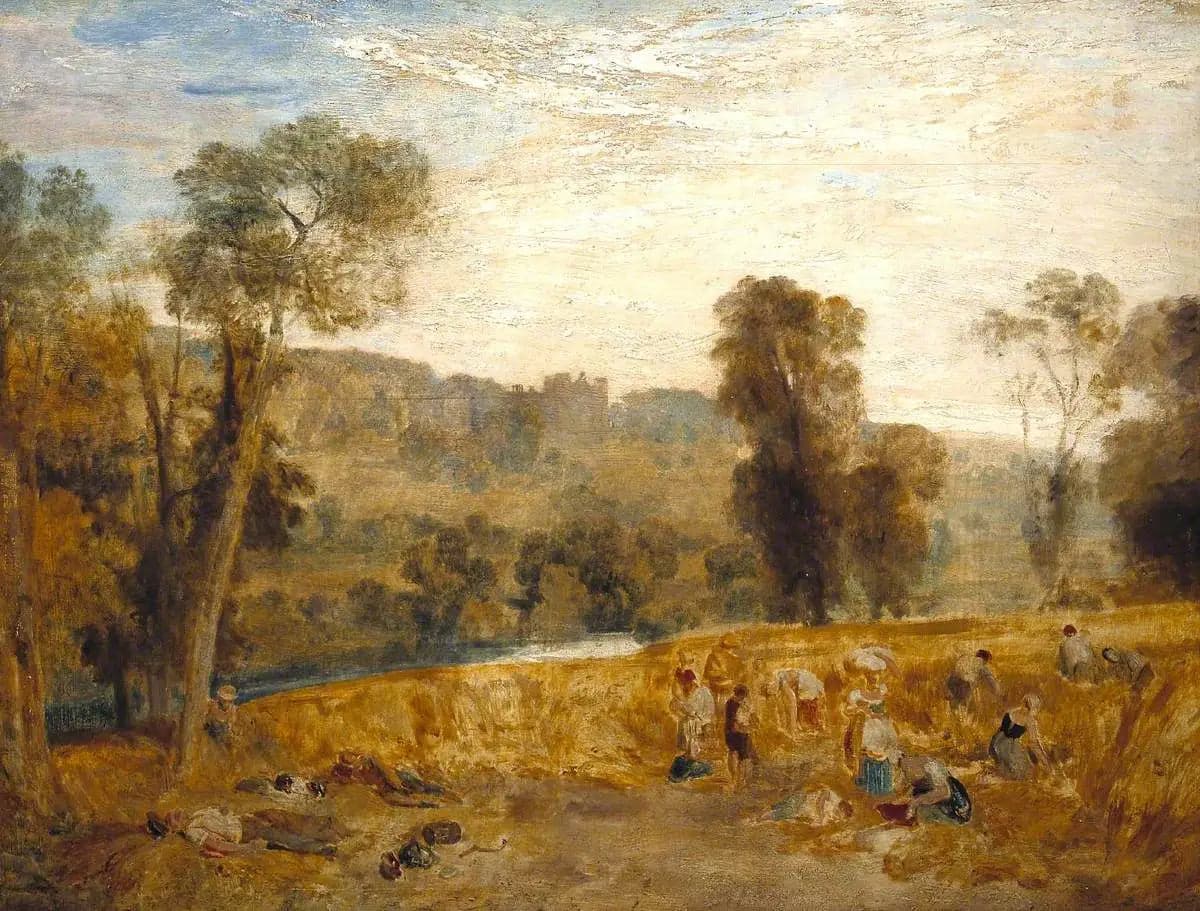
Cassiobury Park: Reaping
- Original dimensions
- 90.2 x 121.9 cm
- Museum
- Tate
- Year
- 1807
Scene depicted
The painting “Cassiobury Park: Reaping” immerses the viewer in a bucolic scene where peasants, in the golden light of the setting sun, are busy harvesting wheat. Turner plays with the nuances of light and shadow, vibrating the atmosphere of this pictorial work with an emotional realism , symbolizing an intimate bond between man and the earth.
Historical context
Created in 1807 at Cassiobury Park, in the Hertfordshire region, this painting is a perfect example of the British romantic movement. Turner, one of the greatest masters of art, captures not only the natural beauty of the park but also the very essence of the era, marked by a deep respect for nature and a quest for transcendence. Today, this canvas is preserved at the Tate , a living symbol of Turner's creativity.
Place in the artist's career
This canvas represents a turning point in Turner's career, marking the peak of his romantic style. Alongside famous works such as “The Shipwreck of Hope” and “The Sunrise,” we can observe both a technical and emotional evolution, further affirming the mastery of the movement of light and colors.
Anecdote
“Nature itself is the best of muses,” said Turner. Inspired by a beautiful morning, he stood in the park, surrounded by the gentle rustle of leaves and the soft light filtering through the branches. This moment of wonder is powerfully reflected in the canvas , immortalizing a fleeting instant of eternal beauty.