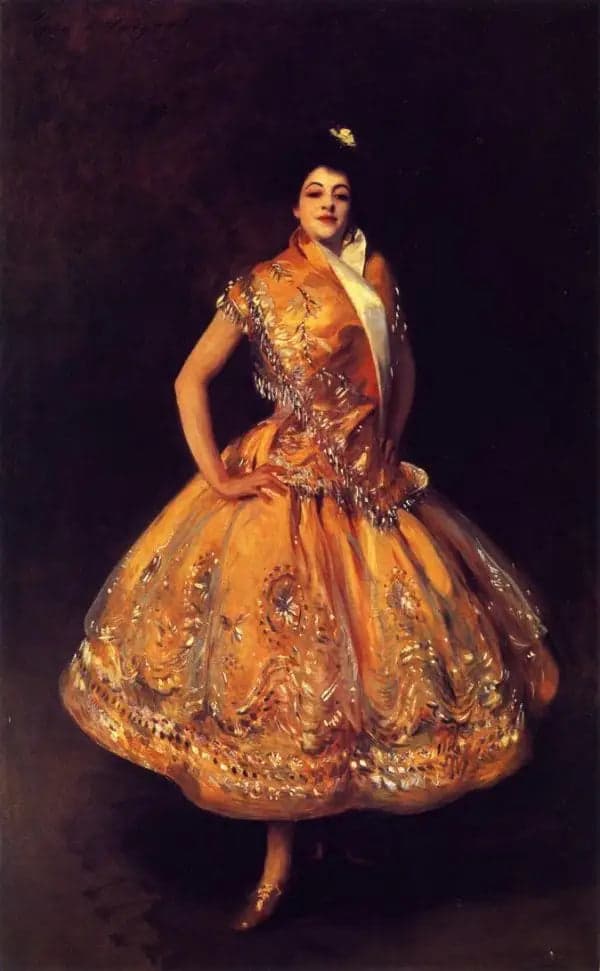
Carmencita
- Original dimensions
- 1.4 x 2.29 cm
- Museum
- musée d'Orsay
- Year
- 1890
Scene depicted
In this pictorial work, Sargent offers us an enchanting vision. The dancer Carmencita reveals herself at the heart of a captivating staging, embodying the spirit of Spanish culture. Through her graceful gestures, she embodies not only the energy of a lively performance but also the sensuality of an era where dance and art intertwined to create a visual symphony. The painting, through its meticulous details, immerses us in a vibrant universe of colors and light.
Historical context
Created in 1890, in Paris, this iconic work is the perfect reflection of the Impressionist movement, which captured the light and truth of modern life. In a vibrant artistic environment, John Singer Sargent , a major figure of the late 19th century, managed to immortalize the fleeting beauty of the subjects around him. Today, this exceptional painting is located at the musée d'Orsay , a prestigious place dedicated to Impressionist and post- Impressionist art.
Place in the artist's career
La Carmencita represents a key moment in Sargent's career, a fusion between his technical mastery and his marked interest in the representation of human figures. Through this painting, we can observe the stylistic evolution compared to other works such as “Carnation, Lily, Lily, Rose” and “Portrait of Lady Agnew.” Each demonstrating a different sensitivity, La Carmencita stands out for its emotional intensity and radiant light.
Anecdote
“Every portrait tells a unique story, and it is up to me to unveil it.” These words from Sargent resonate when reading La Carmencita, where the light of a spring morning dances on the face of the Spanish dancer, thus capturing a vibrant freshness. This canvas does not merely represent; it evokes an ephemeral encounter, a moment frozen in time.